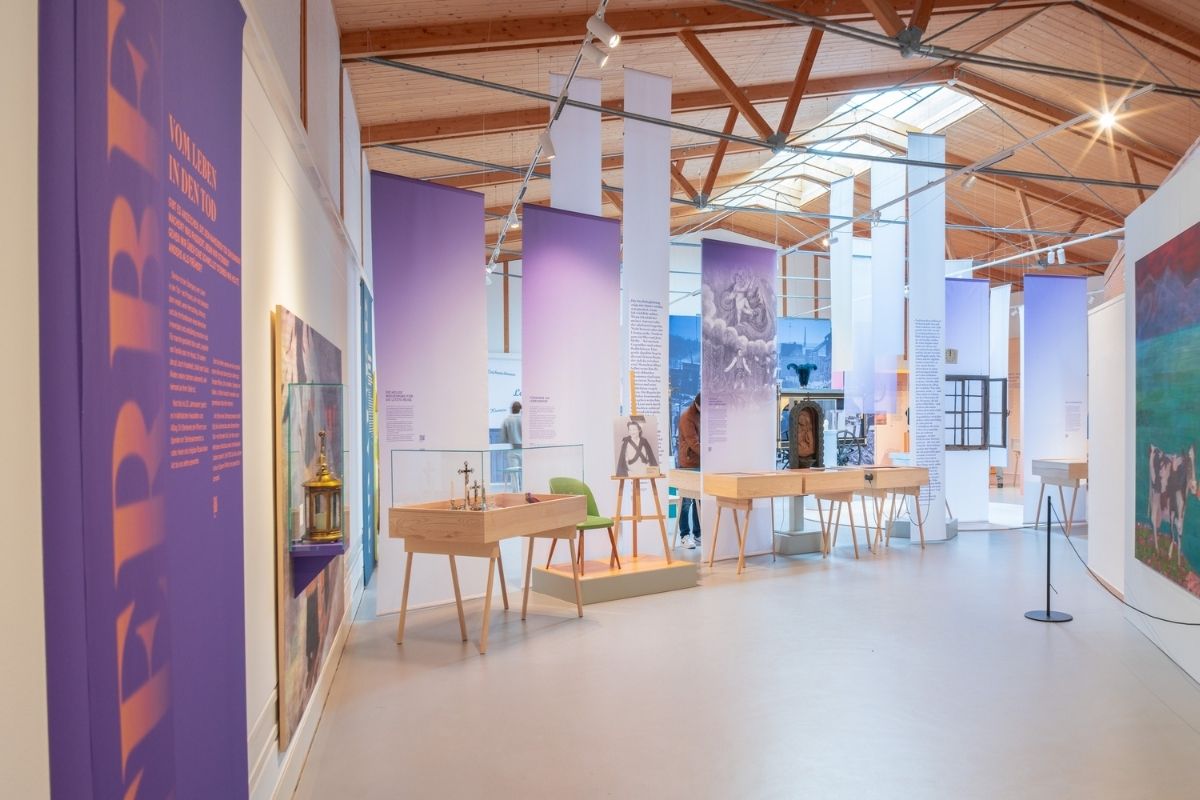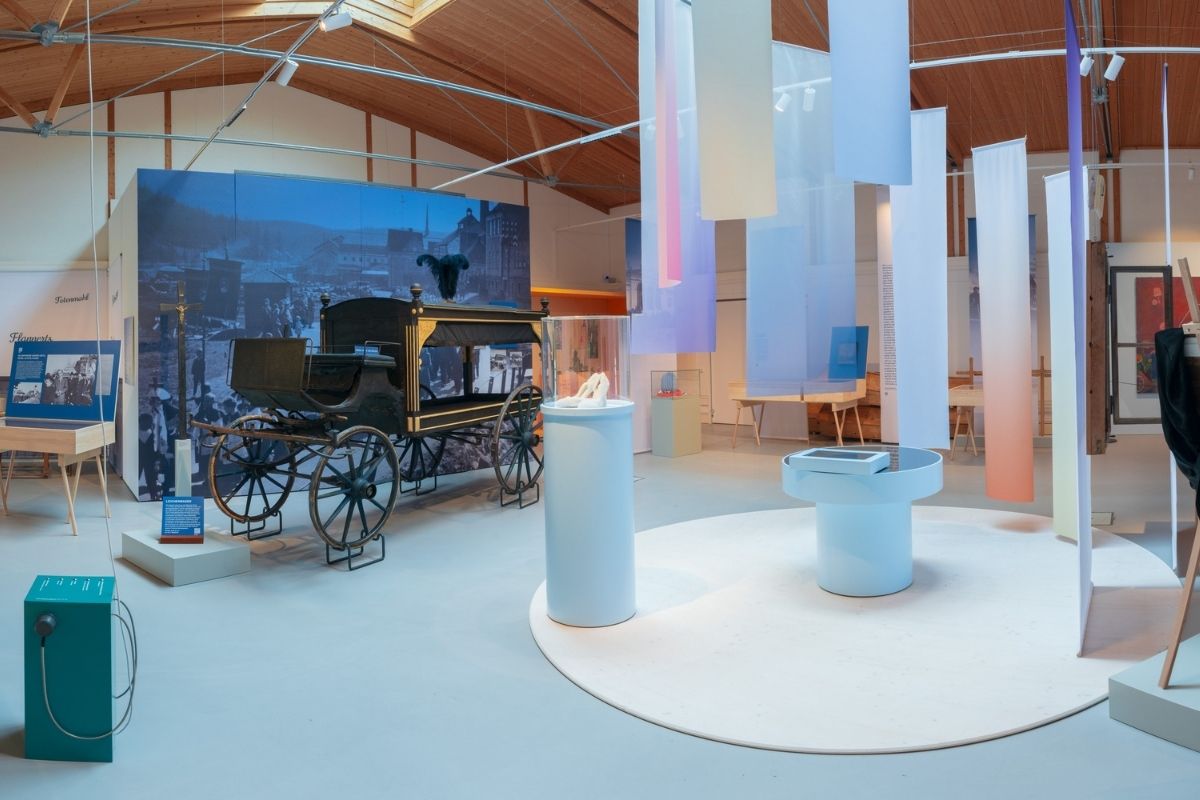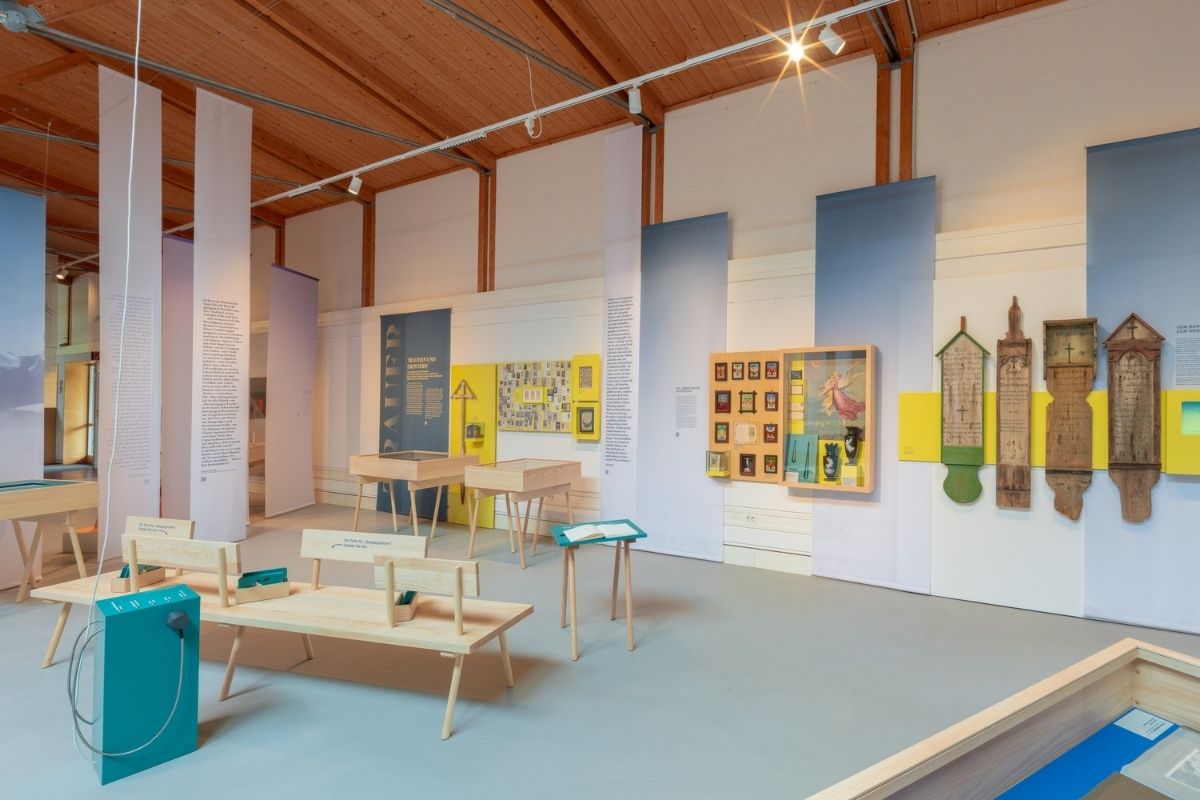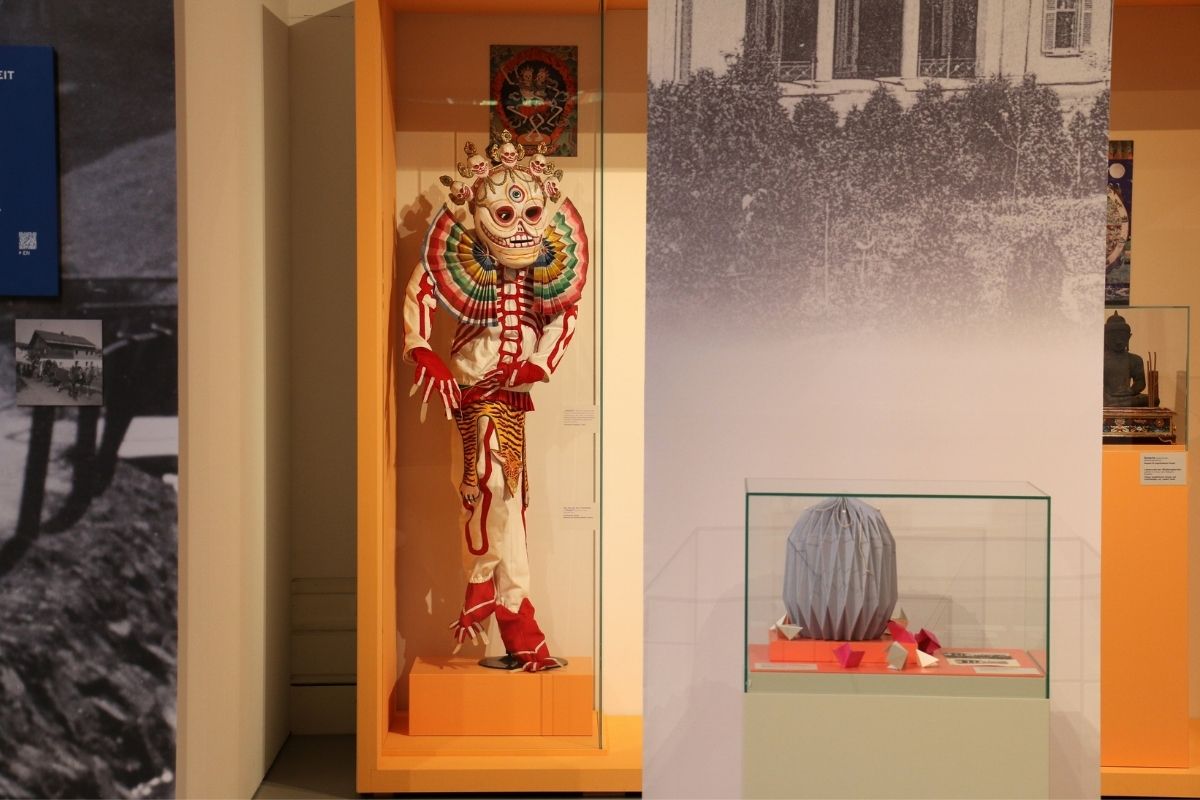

Five of our exhibits are currently on display at the Finsterau Open-Air Museum. With the special exhibition " Now We're Going There – Dying, Death, and Mourning," the Museum of Rural Settlement in the Bavarian Forest invites visitors on a journey: "not away from death, but directly into its many faces," as the exhibition announcement states. "Between old customs and new ideas, a space opens up for questions, memories, and surprising perspectives. What happens when a life ends? How was – and how is – farewell said? And: How do we want to die today?"
And which of our objects can be seen there?
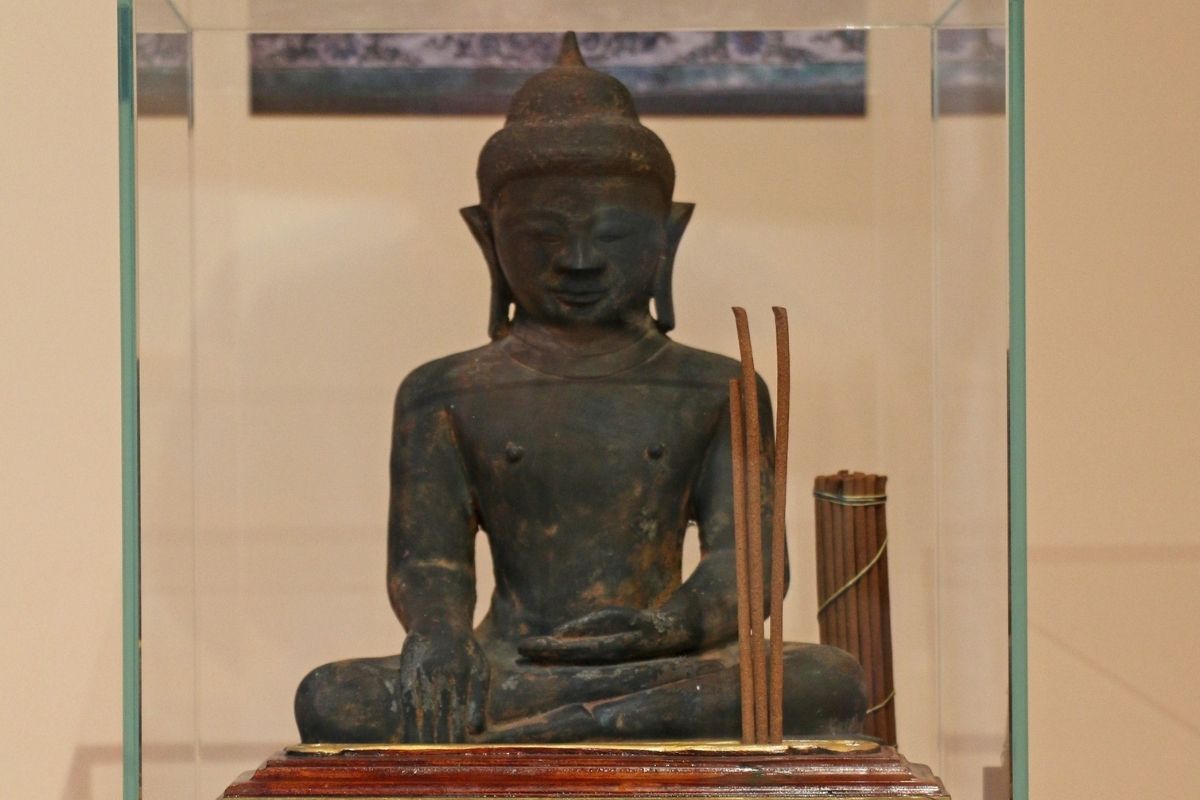
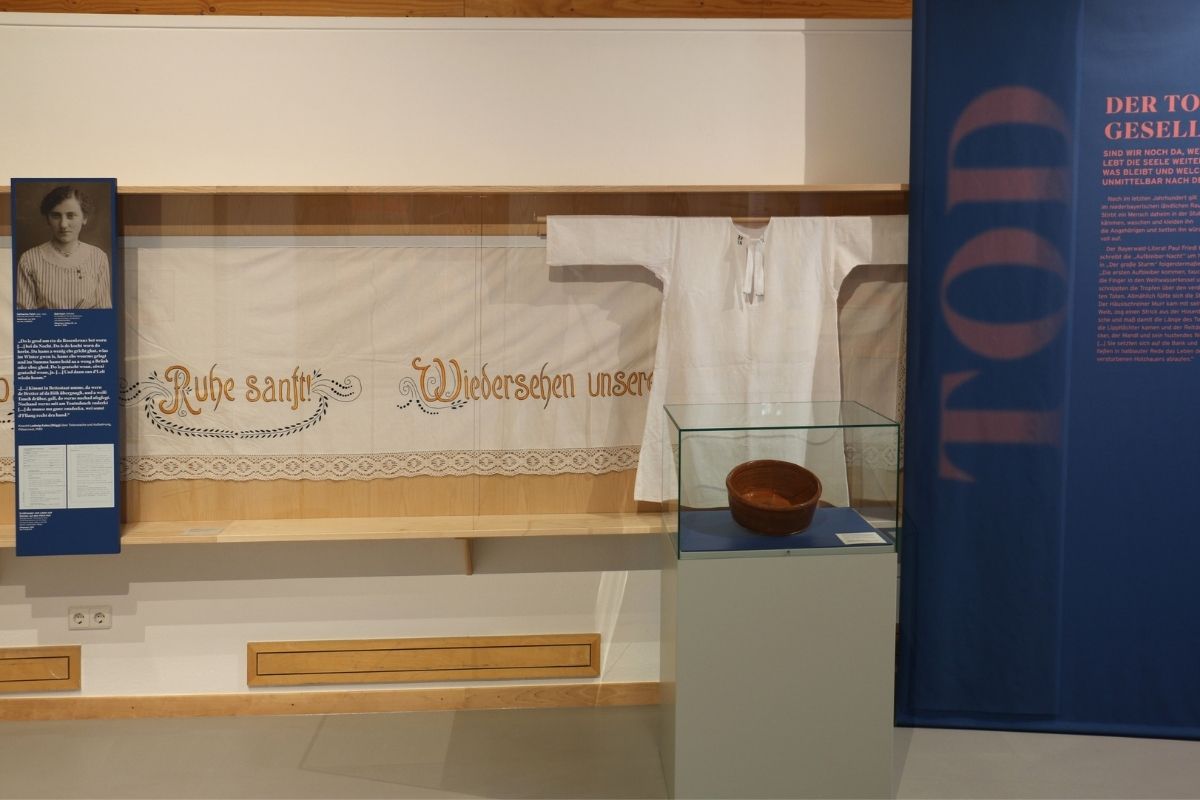
A ceramic funerary washing bowl from around 1900 (AltM2025/2024), a replica of a historical linen shroud from 1871 created in 2018 (M 2019/7), a bronze Buddha figure from the 21st century (M 2013/66), a box for incense sticks with relief decoration in the form of Tibetan lucky symbols from the 21st century (M 2014/23), and a Tibetan death dance costume with mask made of textile and papier-mâché from the second half of the 20th century (AötM 2012/101.1-2).
The red clay washing bowl has decorative grooves on the outside, and the bottom of the bowl has a hole that appears to have been added later. Bowls used for washing the dead were sometimes rendered unusable and stored by punching a hole in the bottom. The added hole therefore possibly indicates that the bowl had been repurposed or that it was used during the washing of the body. However, there is no evidence that this particular bowl was used in precisely this context.
The replica of the historical linen shroud from 1871 is white, loose-fitting, and cut in a slight A-line. Its semicircular neckline splits at the chest and can be closed with a white trim band by tying a knot or a bow. The ends of the trim band are hand-stitched with black thread. Below the neckline, letters or initials and a year are embroidered in black thread ["BF" "HS" (1st line), "18" "71" (2nd line)]. A shroud is a garment worn by a deceased person after their death and in which they are buried.
The bronze Buddha figure displays the Bhumisparsha Mudra. This is an earth-touching gesture that refers to the moment of Buddha's enlightenment under the Bodhi tree in Bodh Gaya, when he called upon the earth to witness his awakening.
The incense stick box serves as a holder for incense sticks, which can be inserted vertically into the designated openings. On the front are four of the eight auspicious Buddhist symbols (Ashtamangala). From left to right, these are the endless knot, a lotus, a conch shell, and the Dharma wheel. The Ashtamangala are among the most important imagery in Tibetan Buddhism. They are believed to have a protective and auspicious function and represent the central teachings of Buddhism.
The Tibetan Dance of Death costume with mask is a costume for the so-called Durdag Cham. These are traditional Tibetan Buddhist dances that primarily serve to remind people of the impermanence of all existence and simultaneously help overcome inner obstacles on the path to enlightenment. The masks of the costumes usually depict, as in this exhibit, a human skull with a cheerful expression, and the clothing typically features a human skeleton.
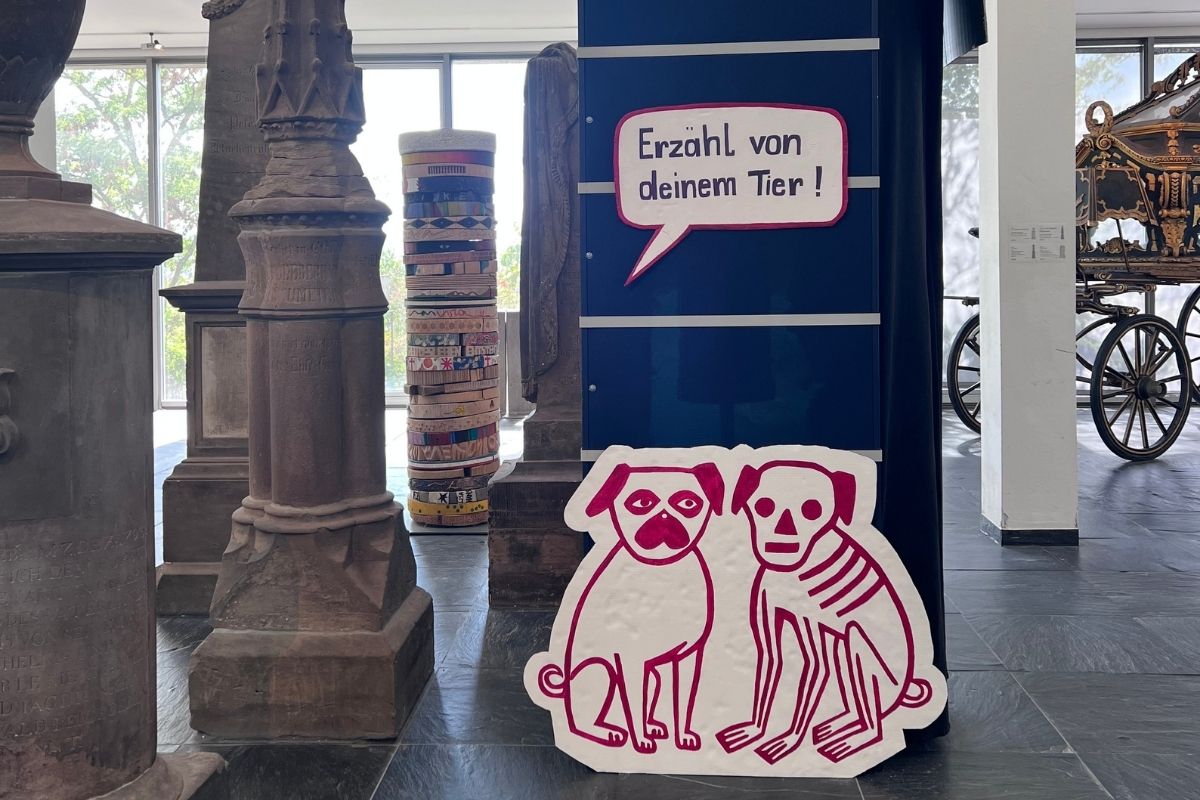
The exhibition in Finsterau explores the diverse cultural traditions, rituals, and ideas surrounding dying, death, and mourning. It combines historical objects from Lower Bavaria with contemporary art, media stations, and sound installations. The exhibition deliberately avoids a somber presentation, opting instead for a vibrant and colorful design that encourages reflection and open dialogue ( freilichtmuseum.de ).
Pictured here: Open-air museum in Finsterau, Museumsstraße 51, 94151 Finsterau
Exhibition dates: March 28, 2026 to April 04, 2027
Further information at: Now we go there – Dying, death and mourning – Open-air museums Massing and Finsterau