
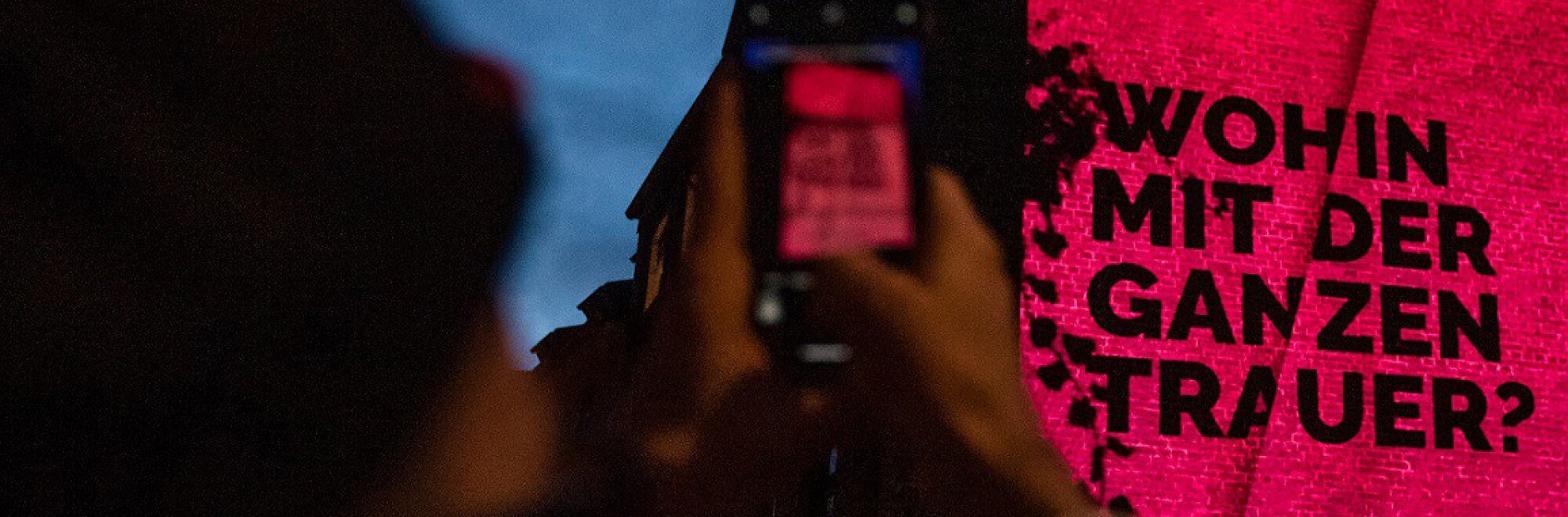
Where does all the grief go?
The Working Group for Cemeteries and Monuments (Arbeitsgemeinschaft Friedhof und Denkmal e. V.) calls for social change:
Grief needs appreciation and new spaces.
Nearly one million people die in Germany every year (954.874 in 2018 according to the Federal Statistical Office), leaving behind millions of grieving relatives. But does society still adequately support and accompany those who are grieving? Only by recognizing, understanding, and valuing their needs can we empower them to navigate this difficult phase of their lives in the best possible way. And these needs have changed: According to the latest studies, healing grief requires, above all, individual rituals, which are often (still) not permitted in cemeteries.
The Working Group on Cemeteries and Monuments (Arbeitsgemeinschaft Friedhof und Denkmal e. V.) therefore demands, especially in light of increasing private competition, that cemeteries, as still the most important place for processing grief, renew themselves. Only in this way can grief become unburdened remembrance. Even modern, often anonymous forms of burial do not offer optimal conditions for this. Two recent scientifically sound studies by trend researcher Matthias Horx and sociologists Dr. Thorsten Benkel and Matthias Meitzler have reached these conclusions.
Student competition 2020
The theme of the competition, whose winners have now been selected, is the contemporary development of cemeteries. Current societal trends in dealing with dying, death, and grief are also changing the demands placed on burial sites. Therefore, we ask about the cemetery of the future. What might a cemetery look like that better meets the needs of mourners and takes into account the psychological functions of a burial site? What could such a cemetery offer – not as a place for the dead, but as a space for the living? What design and services could contribute to giving grief an active place in society and destigmatizing death and grief?
The aim of the competition is to design suitable spaces, including spatial situations, within the Hamburg-Ohlsdorf Cemetery that facilitate individual or communal rituals and acts of farewell. In this spirit, the competition sought innovative, experimental, or even daring concepts. The challenge was to design situations within an overarching structure that could be designed, perceived, and used in diverse ways. These spaces, or spatial situations, should enable mourning practices for different social groups. The socio-spatial structure should comprise private, communal, and public areas. Spending time at the burial site should have a healing and positive effect on people.


Healing Farewells
October 25, 2019 in the MATERNUSHAUS, Cologne
Rethinking cemeteries
Many cemeteries fail to adequately address the necessary aspects of coping with grief. Many of the burial options offered do not help grieving relatives and contribute to the lack of appeal and declining acceptance of existing cemeteries.
BE THERE WHEN THE FUTURE HAPPENS
To create a socially accepted and attractive "space for mourning" for the bereaved, and to establish it as a valued place for grieving people, it is essential to integrate it into the heart of society itself. The needs of the people must be at the center of the cemetery of the future. Scientifically sound studies show that the burial options offered in cemeteries must meet the requirements of what is considered a successful grieving process. Only in this way can the cemetery be a useful burial site and attractive and helpful for the bereaved. It is possible to increase the attractiveness of existing cemeteries by focusing on their intangible value, that is, the specific impact of the burial options they offer.
In the future, cemeteries will become "places of mourning" that offer support to people. Learn more about the role cemeteries play and what helpful burial sites look like on October 25, 2019, in Cologne.
Dr. Dirk Pörschmann, Managing Director of the Working Group Cemetery and Monument e. V., Director of the Central Institute and Museum for Sepulchral Culture
Matthias Horx , pioneer of futures research, founder of the Future Institute
You are currently viewing placeholder content from YouTube . To access the actual content, click the button below. Please note that this will involve sharing data with third parties.
More information


mourning/now
What places does grief need? What rituals help? How do other people or cultures deal with grief?
The online magazine Trauer/Now provides answers and offers new clarity. We explore the topic in all its facets. We show solutions and offer inspiration on how to grieve in a healing way when saying goodbye to a loved one.
Healing Farewells
These 1
These 2
These 3
These 4
These 5
These 6
These 7
These 8

Publication
This volume focuses on research findings and psychological analyses that demonstrate how the individuality of the bereaved takes center stage in coping with grief today, and what role the cemetery plays in this process. The central focus is on the crucial importance of actively engaging with grief and, consequently, actively engaging with the cemetery as a place of mourning and burial.
Publisher: Working Group Cemetery and Monument e. V., Kassel
ISBN: 978-3-924447-56-4
Price: 22,80 euros incl. VAT
Material
- Eight theses on the culture of mourning in the age of individuality – Matthias Horx
- press report
- Press release: Federal Association of Funeral Supplies
- Postcard: What to do with all the grief?
- Postcard: When you die, others mourn
- Postcard: Every 33 seconds, a person dies in Germany
- Poster: Where to put all the grief?
- Poster: The dead do not mourn
