
The victory of life
When death was seduced – and died!
"The Victory of Life (Also a Dance of Death)"
Robert Budzinski (DE, 1874-1955)
6 woodcuts in a portfolio, 1924
In studying depictions of death from bygone eras, one encounters, among other motifs, the Dance of Death. Here, death—at least at first glance—presents a decidedly entertaining side. During the late Middle Ages, it typically appears as a musician, playing for a dance and gracefully performing it with members of the social class. Initially conceived as a multi-part series of images, this motif appeared as monumental painting in public spaces until, with the invention of printing, it permeated other forms of narrative and representation. In this way, the originally Christian-motivated concern of confronting humanity with its inevitable end was given a new, accelerating dynamic in public discourse.
With the onset of modernism, the Dance of Death motif underwent a marked transformation. The dance element no longer played a dominant role, and the situational contexts, such as the encounter between 'life' and 'death,' acquired a more individualized character—for example, through a stronger connection to everyday life. Furthermore, scenarios conveying sensuality and passion came to the fore, greatly facilitating the adaptation of the motif composition of 'Death and the Maiden.' In art history, this depiction, strongly influenced by eroticized femininity, is subsumed under the subject of 'Death and Eros': Death charmingly approaches a naked beauty and entices her. Although the beautiful woman usually appears shy or even rejecting, she cannot escape his presence—simply because she cannot! Alongside this, however, occasional adaptations of the motif emerge that break with traditional patterns, for example, by taking their core message to absurd extremes. This is precisely what the artist Robert Budzinski (1874-1955) did in his work "The Victory of Life," first published in 1924, giving the Dance of Death motif a new twist. The omnipotence and inevitability of death are negated in this cycle of eight individual woodcuts. While the focus is on the classic motif of 'Death and the Maiden,' which also incorporates the 'dance,' the encounter between the two takes a highly 'unclassical' turn. It begins with Death, disguised as a musician playing the violin, approaching a naked young woman sitting dreamily in the grass. Upon reaching her, he reaches for her shoulder, which she discreetly tries to fend off. Of course, Death knows how to beguile the beauty: he strikes up a song on his violin, and this indeed entices the young woman to enter his arms and allow them to dance together—close to each other. What begins gently grows increasingly wild, imbuing Death with great determination. He has the woman firmly in his grasp, and surely—how could it be otherwise—he will remain in control. But he is sorely mistaken, for suddenly the tables turn! Death misjudges the energy and willpower of his dance partner and cannot prevent it from being him who emerges victorious from the erotic rendezvous, but rather she—naked, pure life itself. As the dance gains momentum and intensifies, the woman begins to dismember his skeleton. She seizes one bone after another and sends them twirling high into the air. In the final scene, the dance is over: Death lies on the ground as a pitiful pile of bones. On this heap, the naked beauty finally comes to a standstill, her hands on her hips, gazing self-satisfiedly at her prone, destroyed dance partner. She has accomplished the impossible—won the victory of life!
Although the classic characteristic of the Dance of Death is not that death ultimately takes its course, all works depicting the Dance of Death ultimately express a secondary message, one that only Budzinski's particular cycle of paintings manages to convey so powerfully: While the individual human being is subject to death, humanity itself—that is, the social community of all people in a more abstract sense—remains alive. Furthermore, Budzinski's depiction illustrates that death is a constant lurker, but that in real life it is sometimes possible to escape it—at least temporarily.
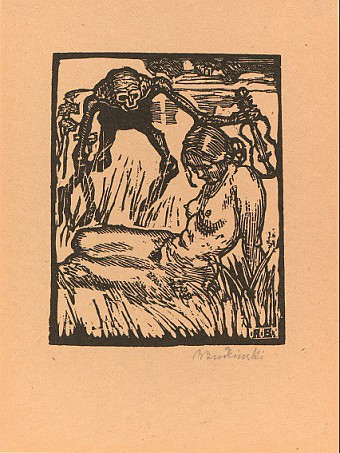
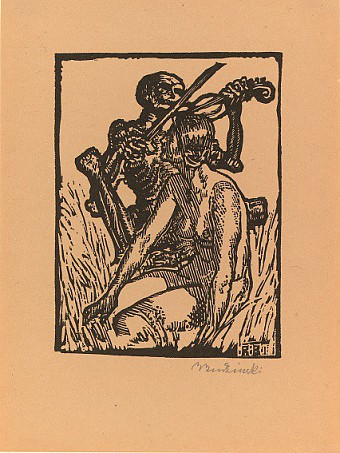
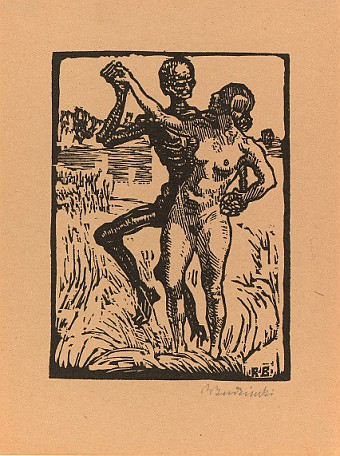
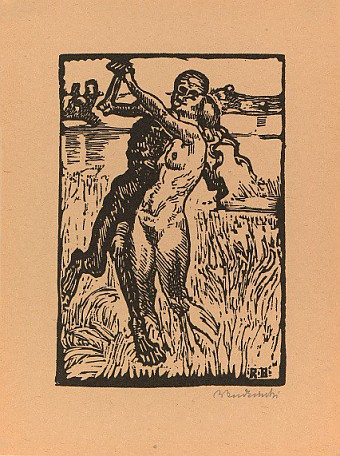
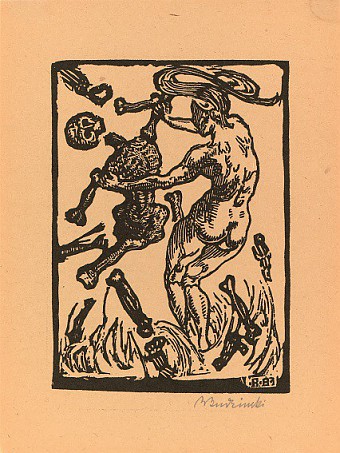
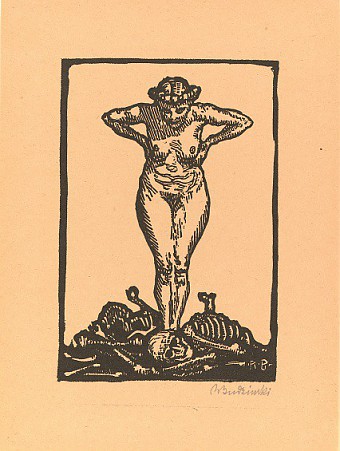
Excerpt from "The Victory of Life" (1924) by Robert Budzinski
© Museum of Sepulchral Culture, Kassel