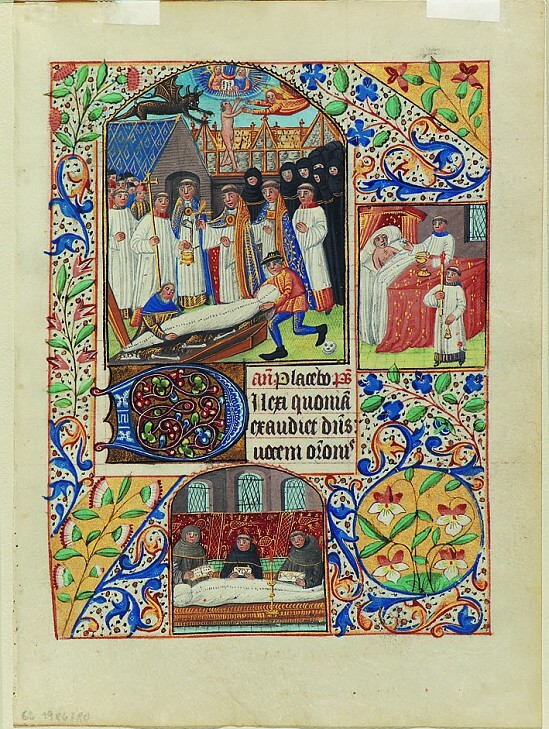
A lesson plan “Placebo domino in regione …”
probably northern France, around 1480
This is a page from a Book of Hours. Books of Hours were prayer and devotional books for the Liturgy of the Hours and emerged in the 13th century. The present example dates from the heyday of Books of Hours, the 15th century. The miniature paintings offer insights into the burial practices of that time. The small image on the right shows a dying man being given the last rites by two clergymen—friars. In the lower image, the Office of the Dead is being performed by friars, for which the deceased has been laid out and wrapped in a shroud. The main image above is dedicated to his burial. Several clergymen of the religious order, clad in white liturgical vestments, preside over the ceremony. Two gravediggers lift the deceased from the coffin to place him in his grave. It is striking that the coffin was thus used merely as a means of transport. This is because burials in coffins were by no means obligatory at that time. In addition, there were sometimes purely external circumstances that argued against the use of coffins as burial utensils, including a shortage of wood or the need to accelerate the decomposition process due to lack of space in cemeteries. The use of a coffin only became mandatory in the 19th century.
Nevertheless, the main image reveals another interesting detail. In the left background, a group of people dressed uniformly in black can be discerned, presumably a so-called burial brotherhood. In this case, they are recruited from the previously alluded-to religious order. Such a religious brotherhood was responsible for ensuring the salvation of the souls of deceased members. That is, they offered intercessory prayers , which usually followed a strict set of rules and included the holding of prayers and Masses. All three images are flanked by vegetal borders and are arranged around Psalm 116:9 (Old Testament): "Placebo domino in regione vivorum ," which translates as: "I will please the Lord in the land of the living." Furthermore, it is important to recognize that the images reflect a so-called work of mercy . In early Christian times, a canon of Christian virtuous practices had developed, which formed into the Seven Works of Mercy – the seventh work being: burying the dead.