The Zizenhausen Dance of Death
Anton Sohn and descendants (DE, 1769–1840)
Produced from 1822 onwards; terracotta, oil paint, paper
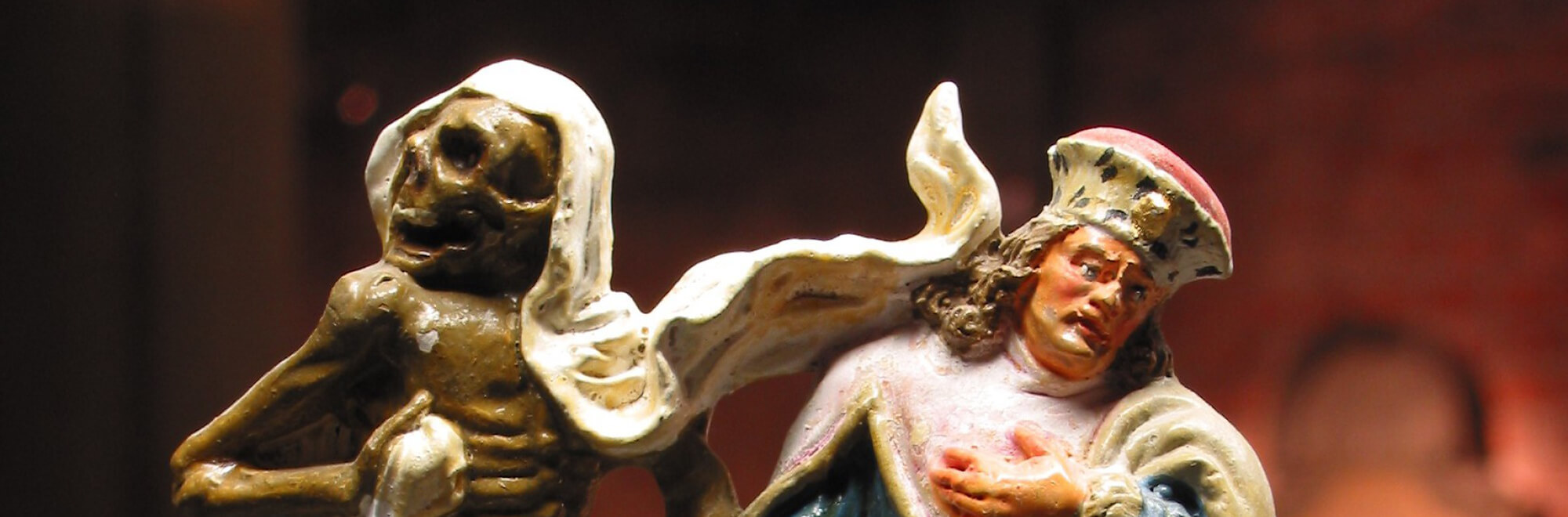
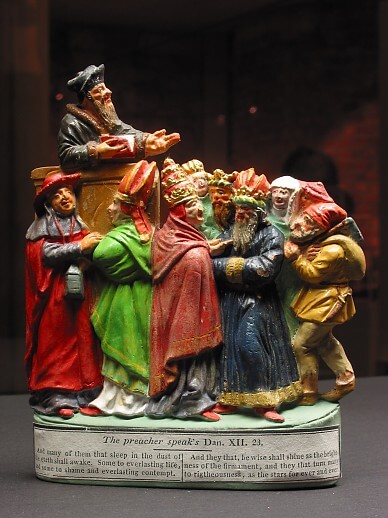
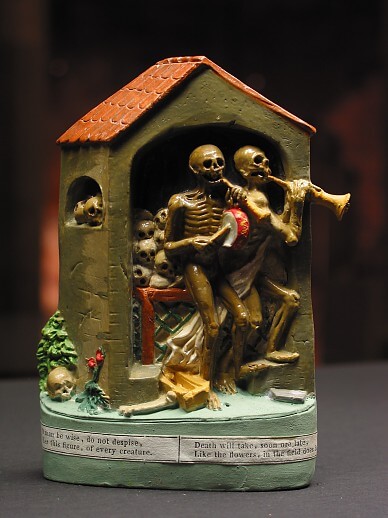
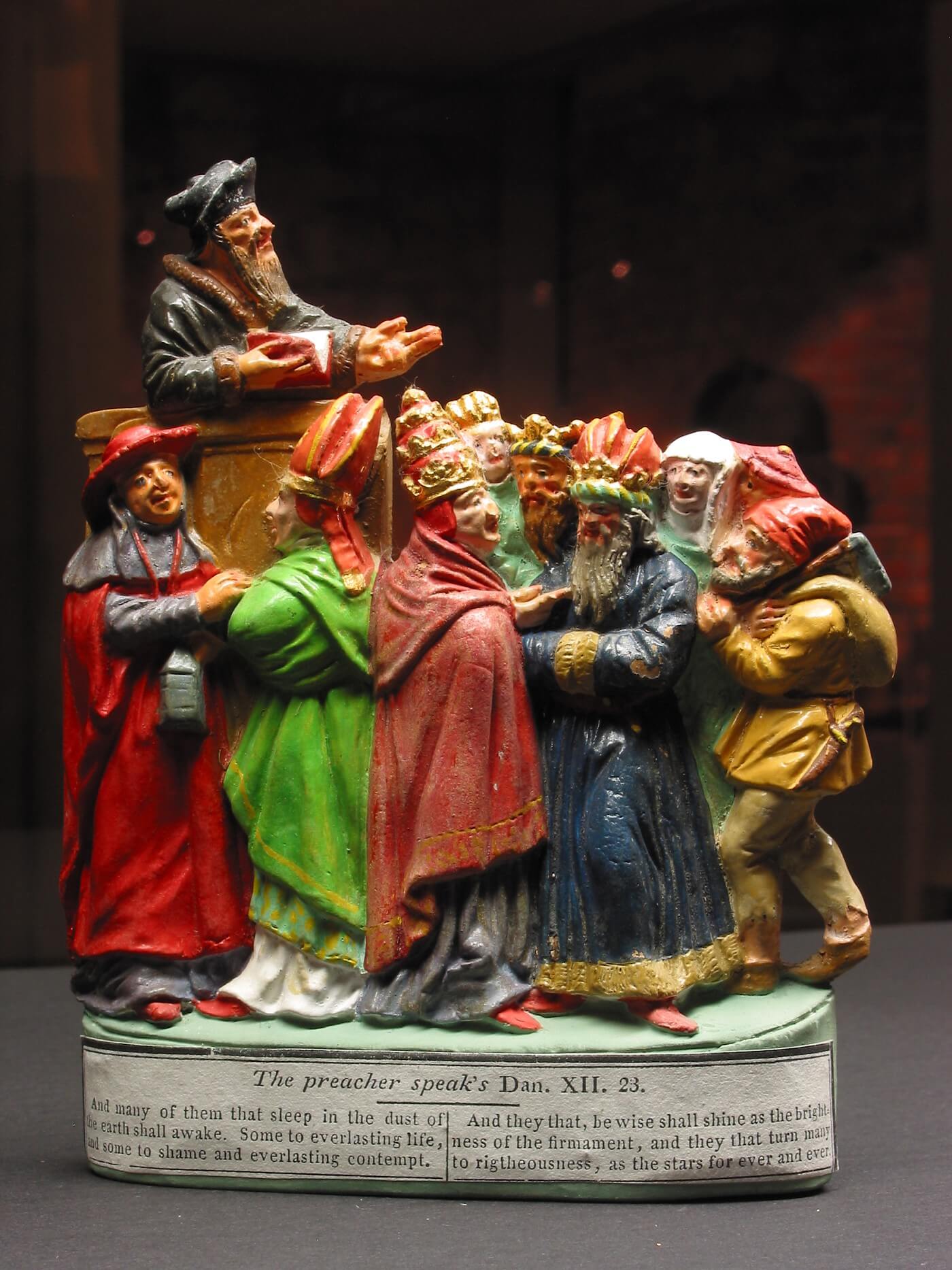
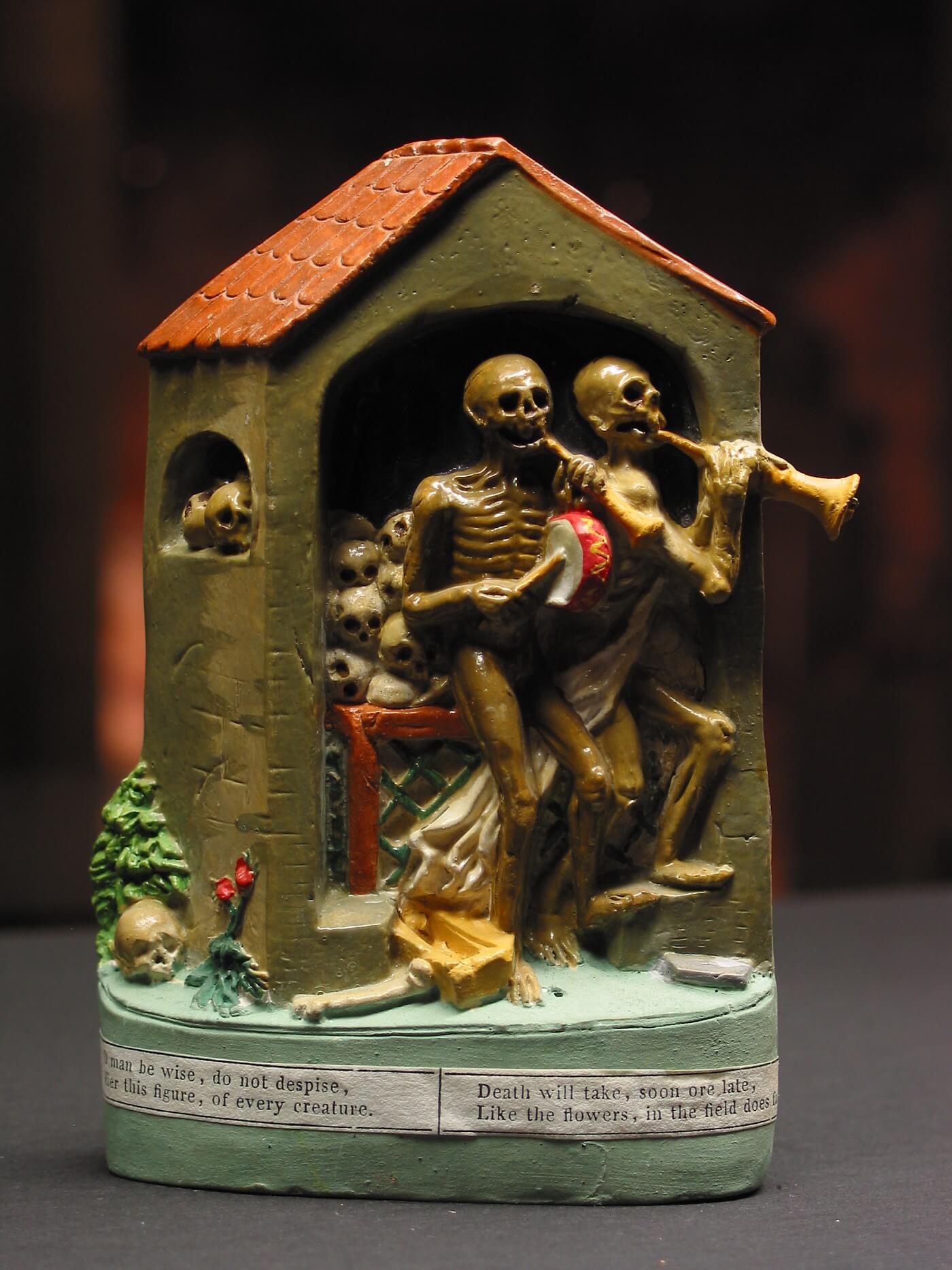
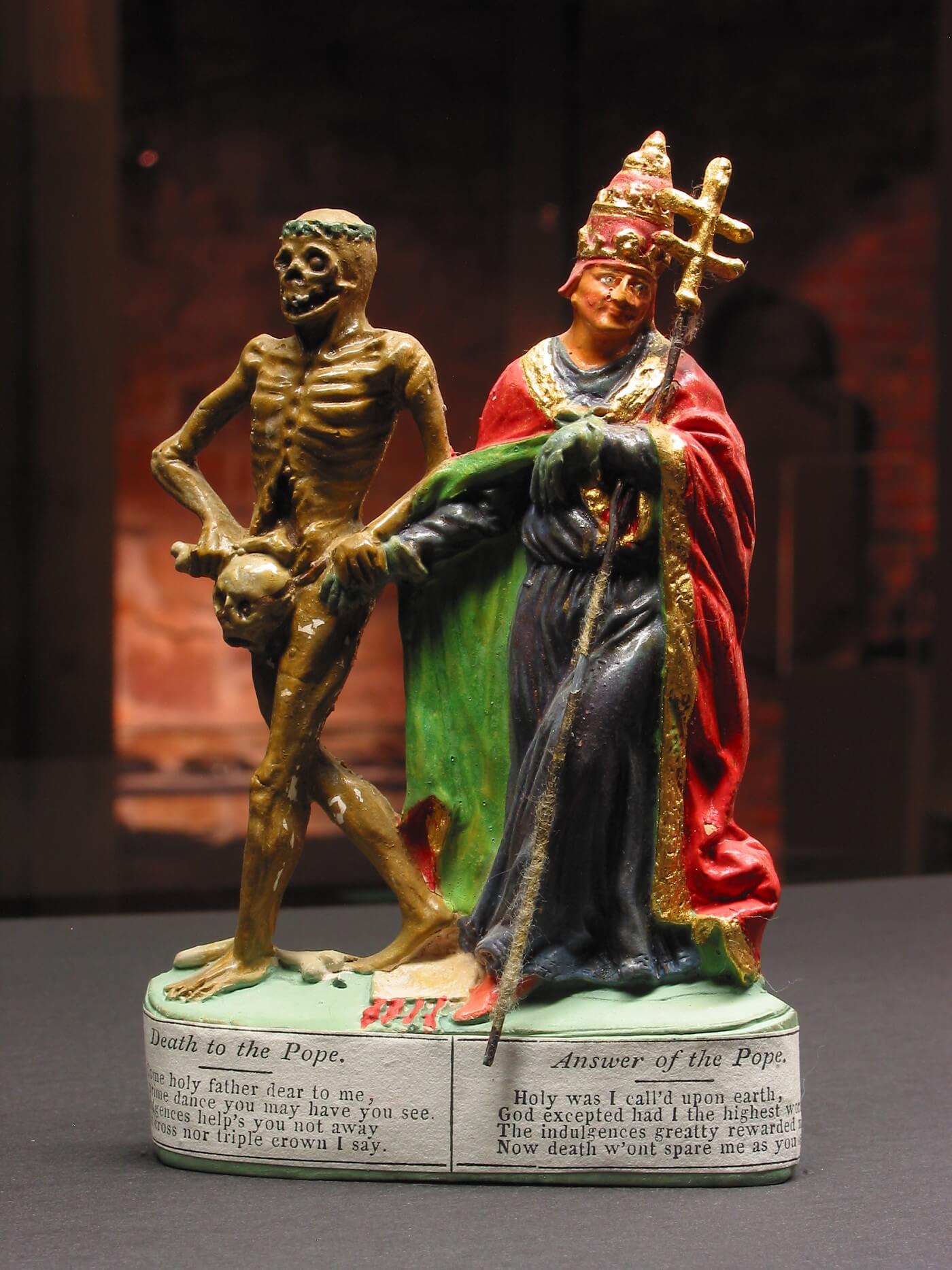
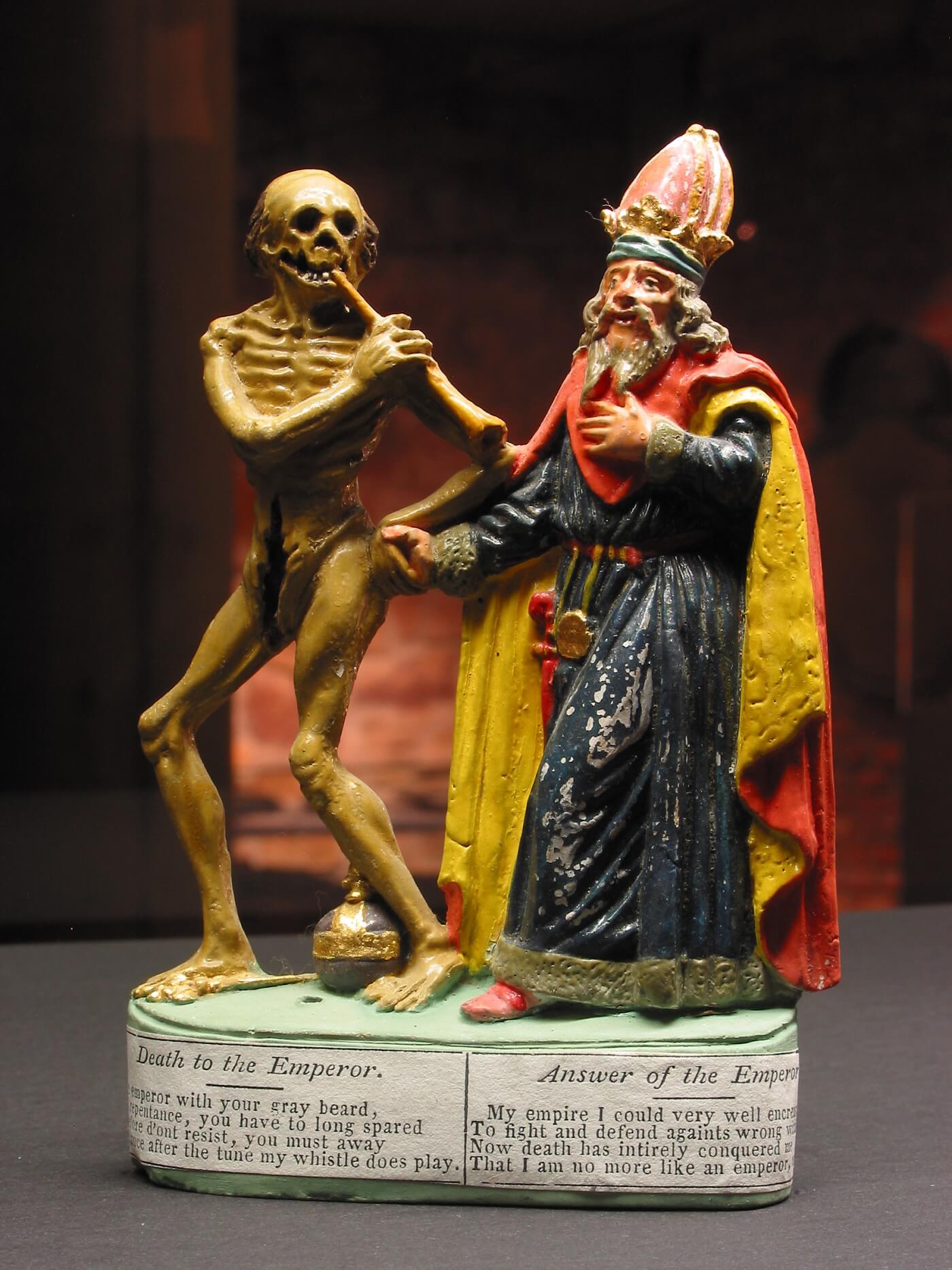
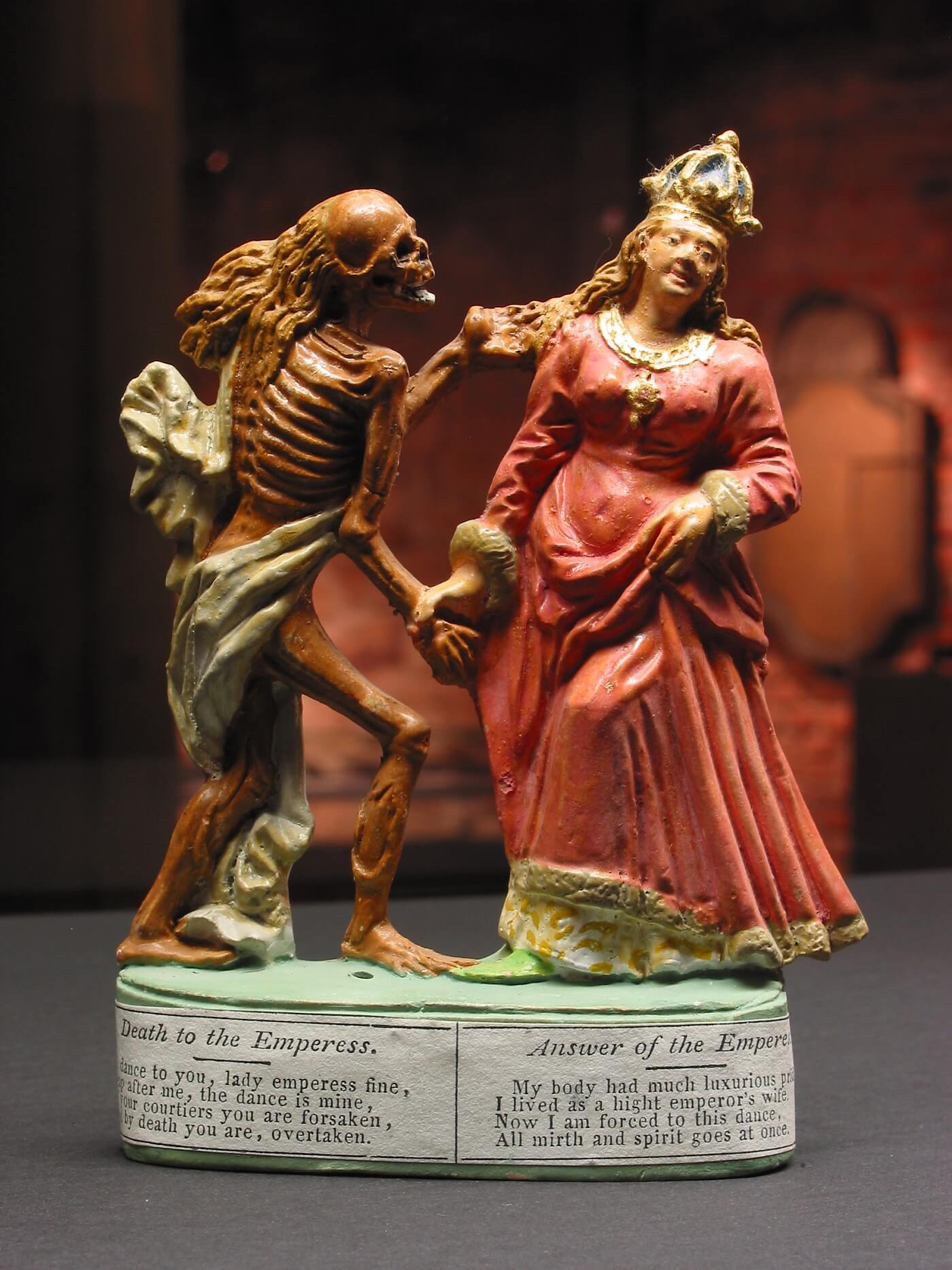
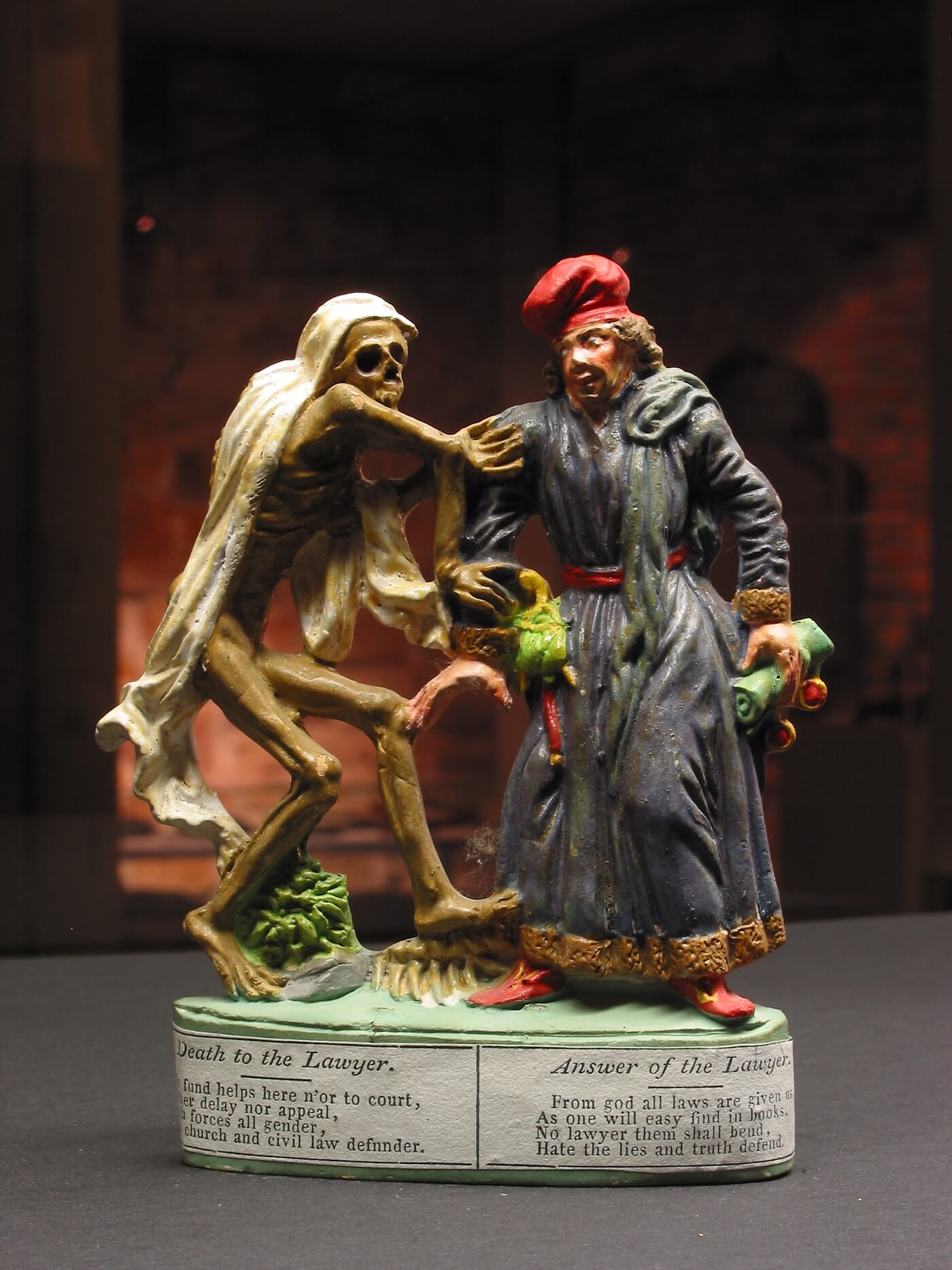
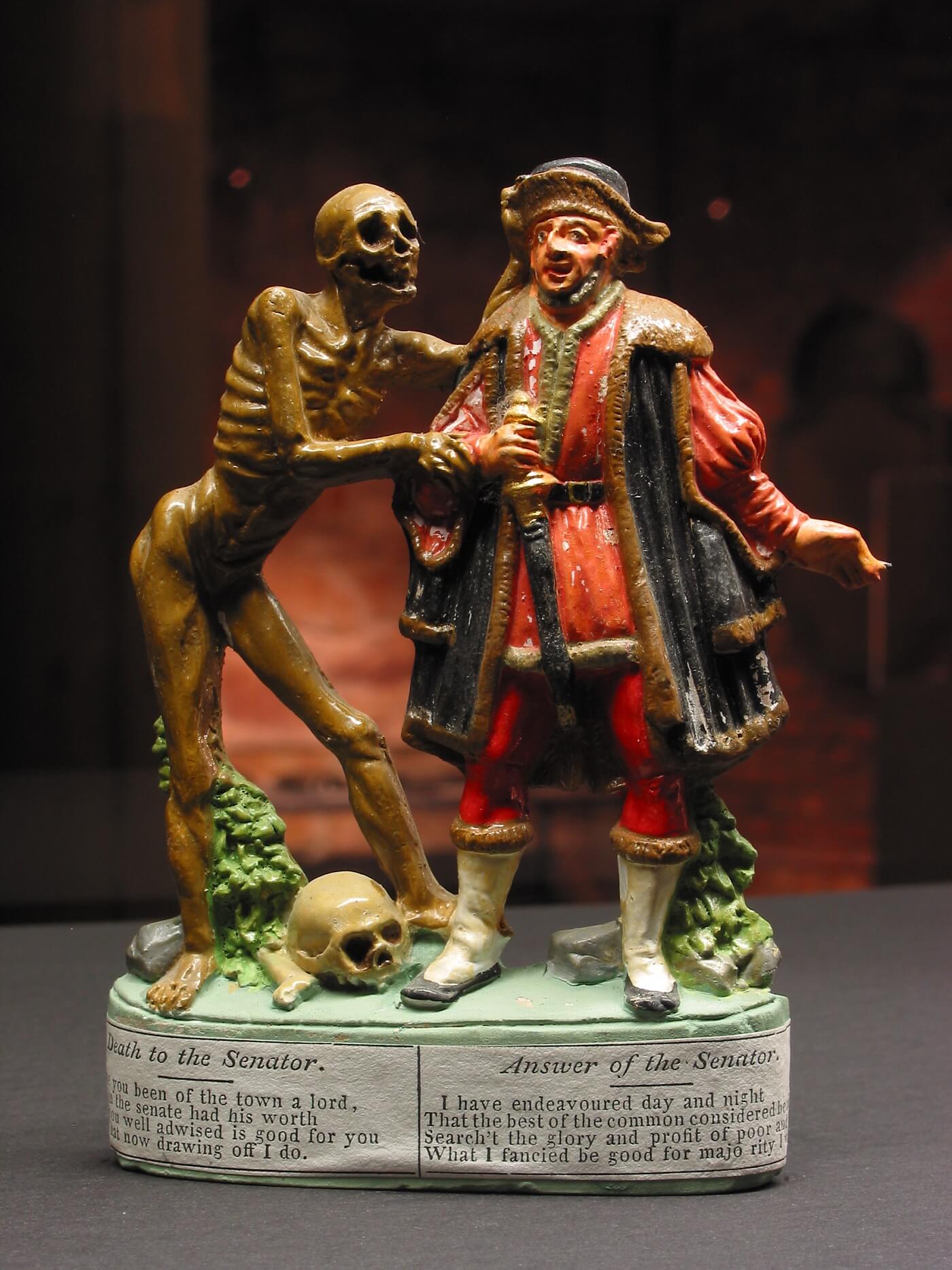
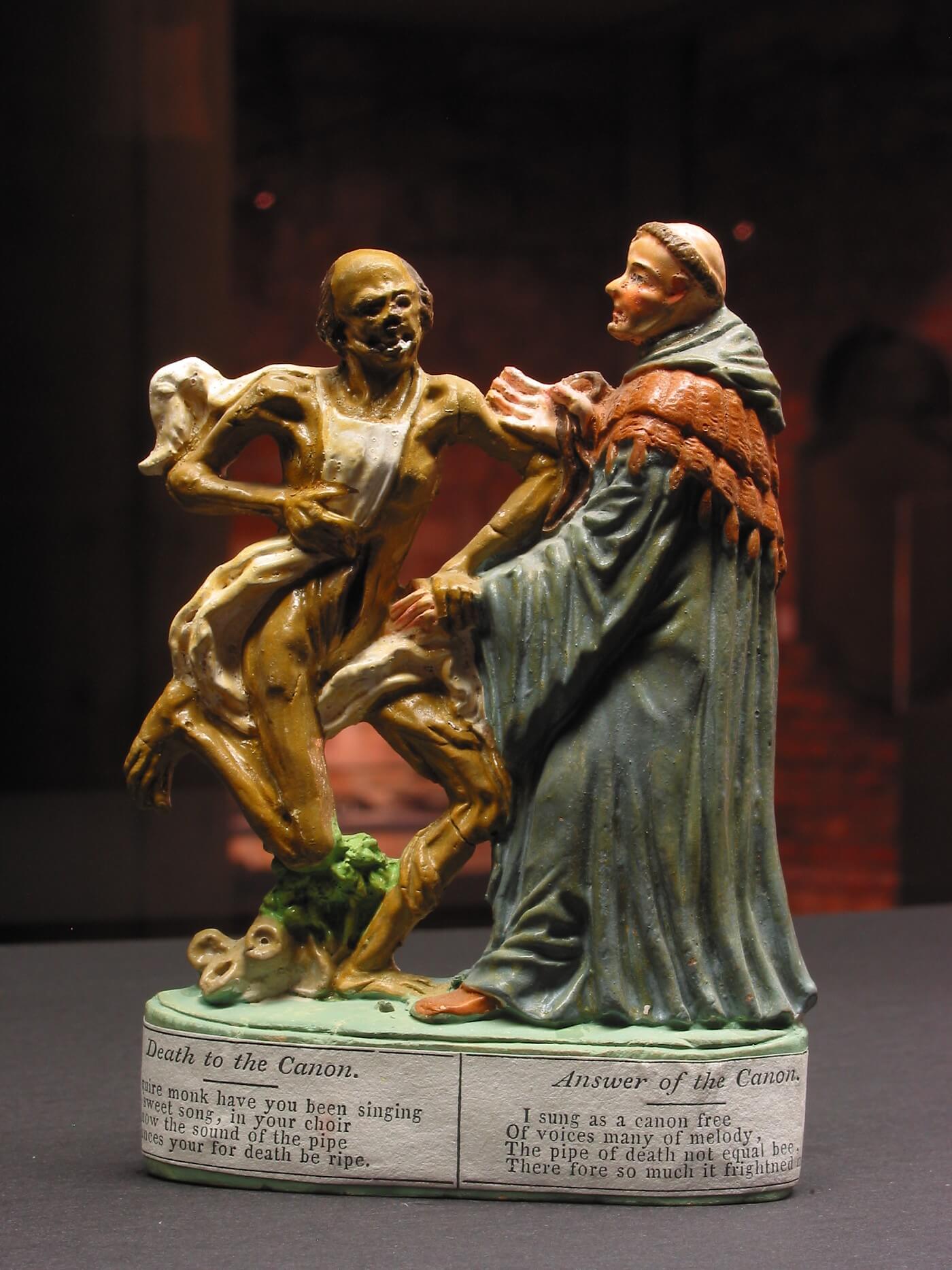
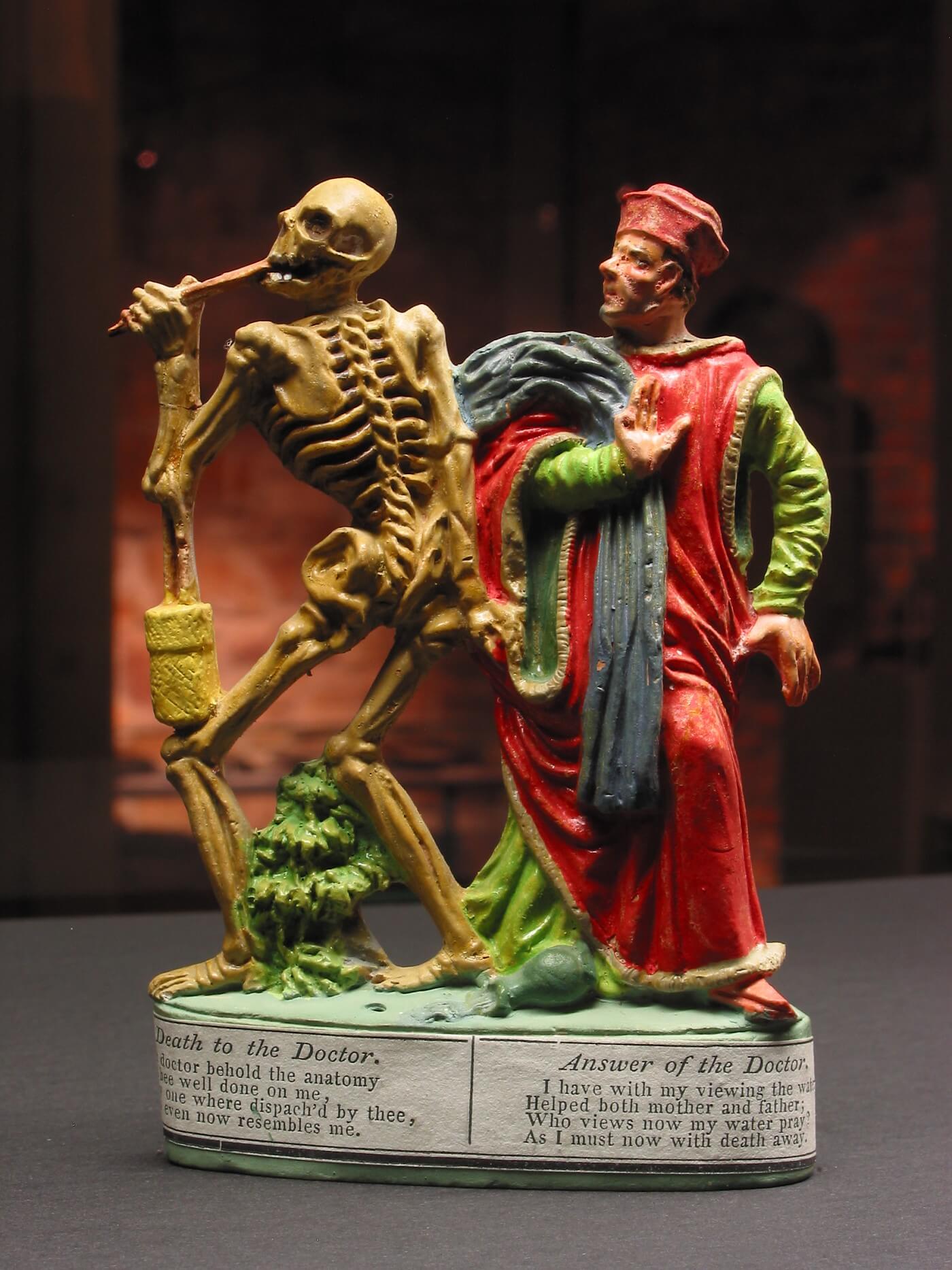
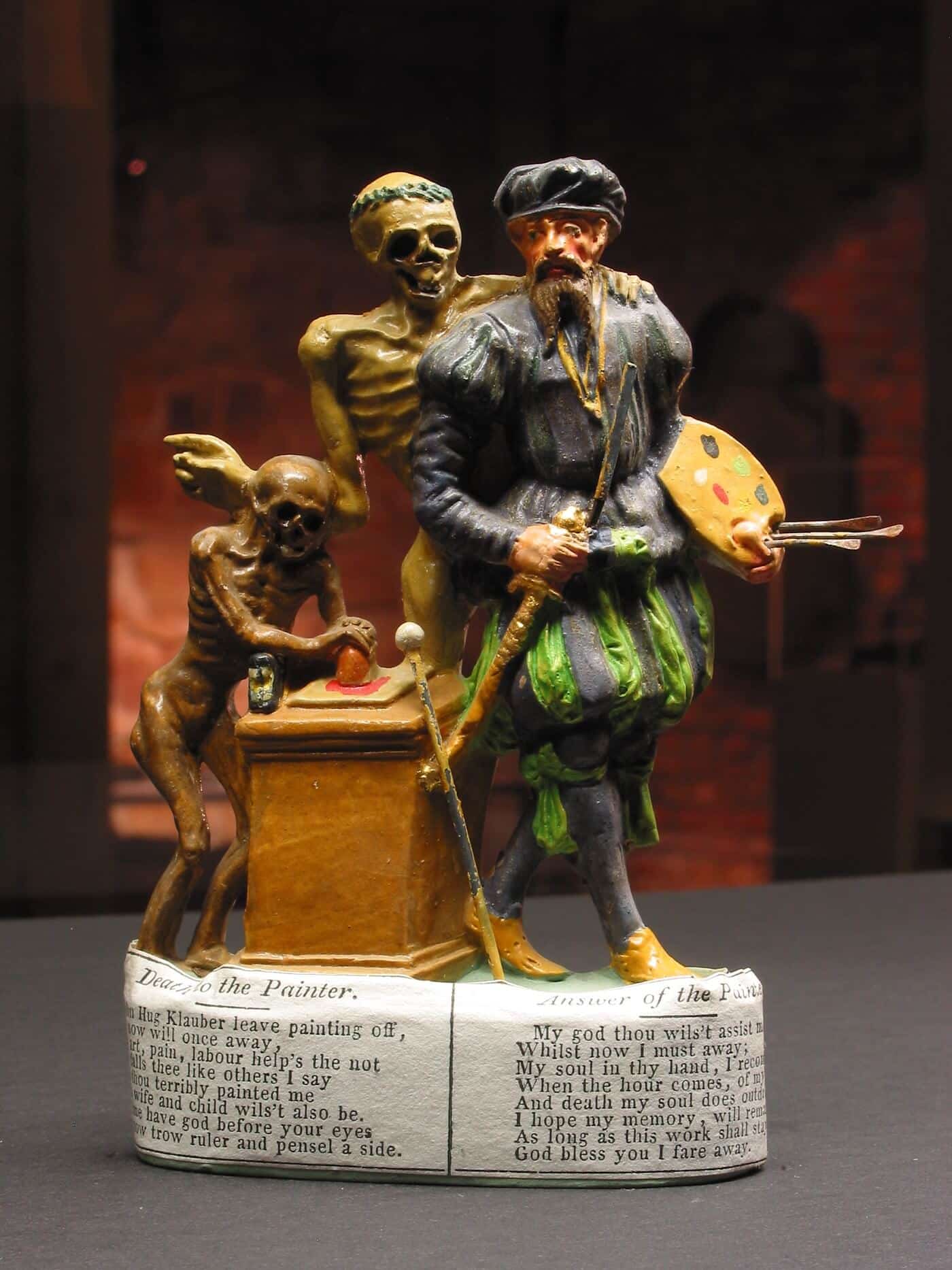
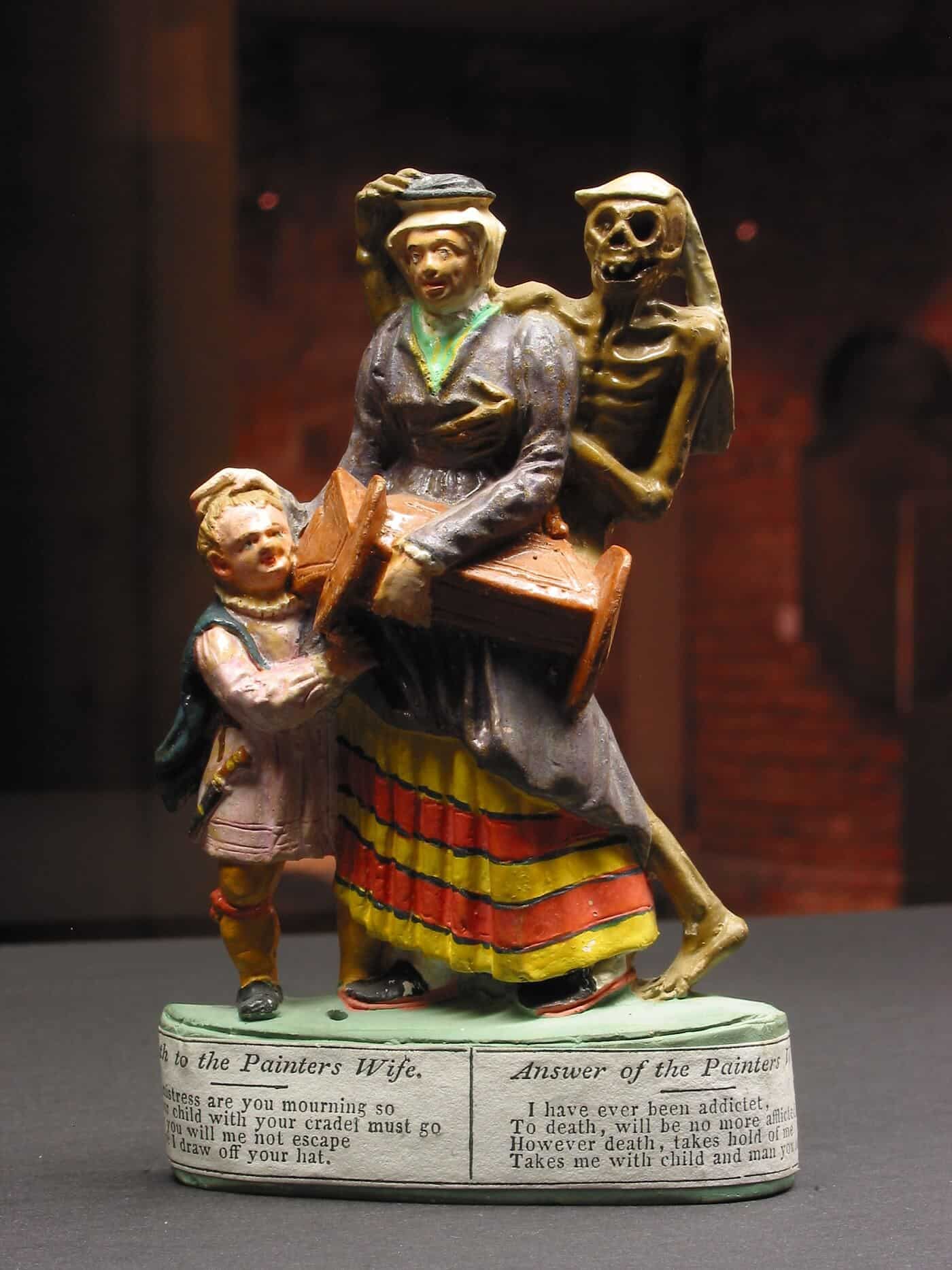
This series of figures is one of the extremely rare complete sets of the Zizenhausen Dance of Death, composed of polychrome terracotta figures and first created in 1822/23 by Anton Sohn (1769–1841), who worked in Zizenhausen near Stockach. Thirty-nine of the 42 sculptures are pairs of figures, each depicting personified Death and a person representing a member of the medieval social order: Pope, Emperor, Empress, King, Queen, Cardinal, Bishop, Nobleman, Noblewoman, Count, Countess, Knight, Lawyer, Senator, Sheriff, Abbot, Abbess, Canon, Physician, Bailiff, Herald, Mayor, Merchant, Youth, Maiden, Pied Piper, Cripple, Usurer, Hermit, Fool, Blind Man, Heathen, Heathen Woman, Jew, Cook, Painter, and Painter's Wife. Three figures, however, do not depict death, but rather Christian-Western motifs such as Adam and Eve, a charnel house scene, and a preacher scene. The pedestals are covered with strips of paper printed with dialogues in verse between the figures or with cautionary messages. The texts in the series shown here are in English. English and also French versions appeared alongside the original German version from around 1835, reflecting the increased interest in tourist travel.
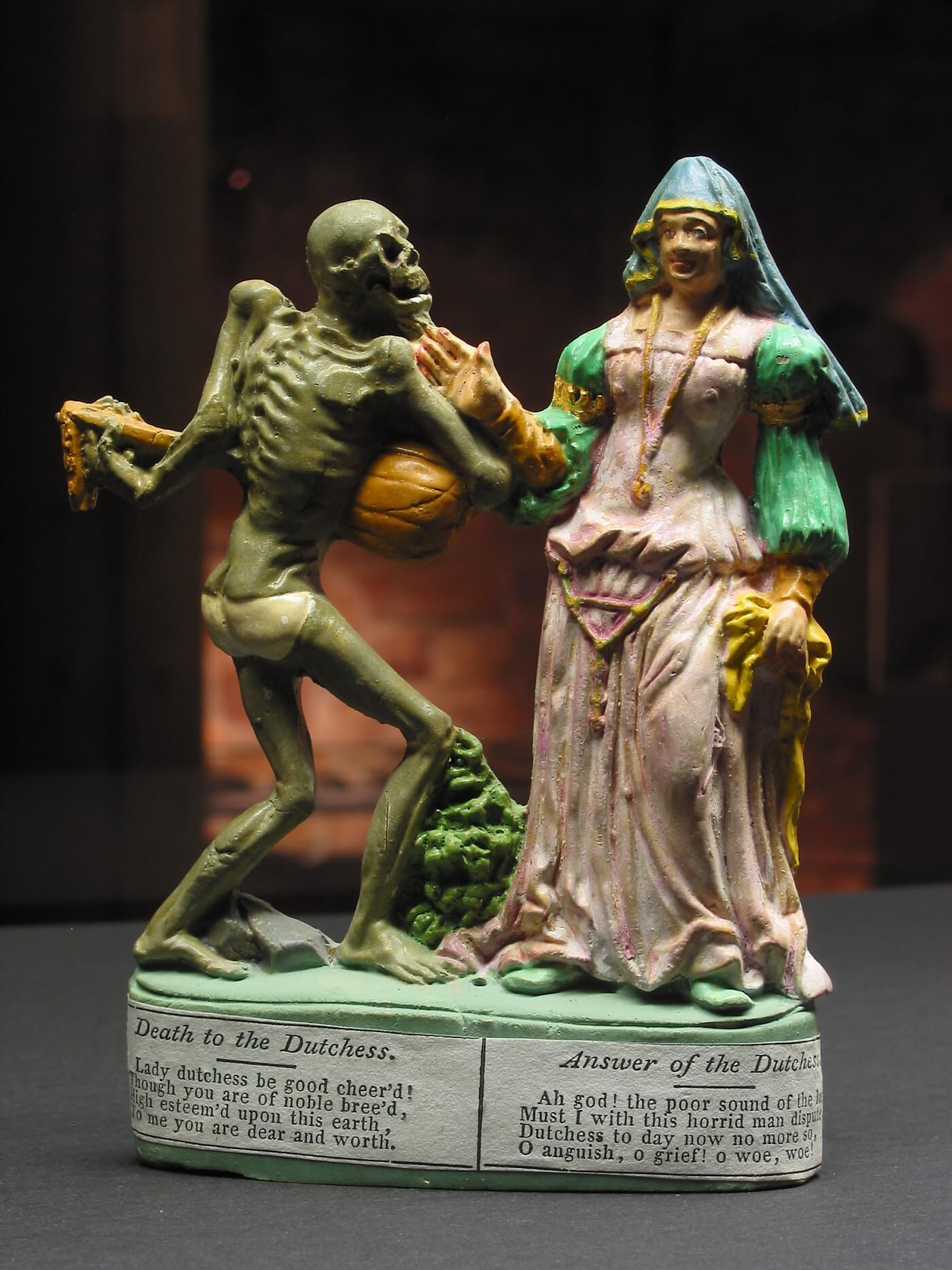
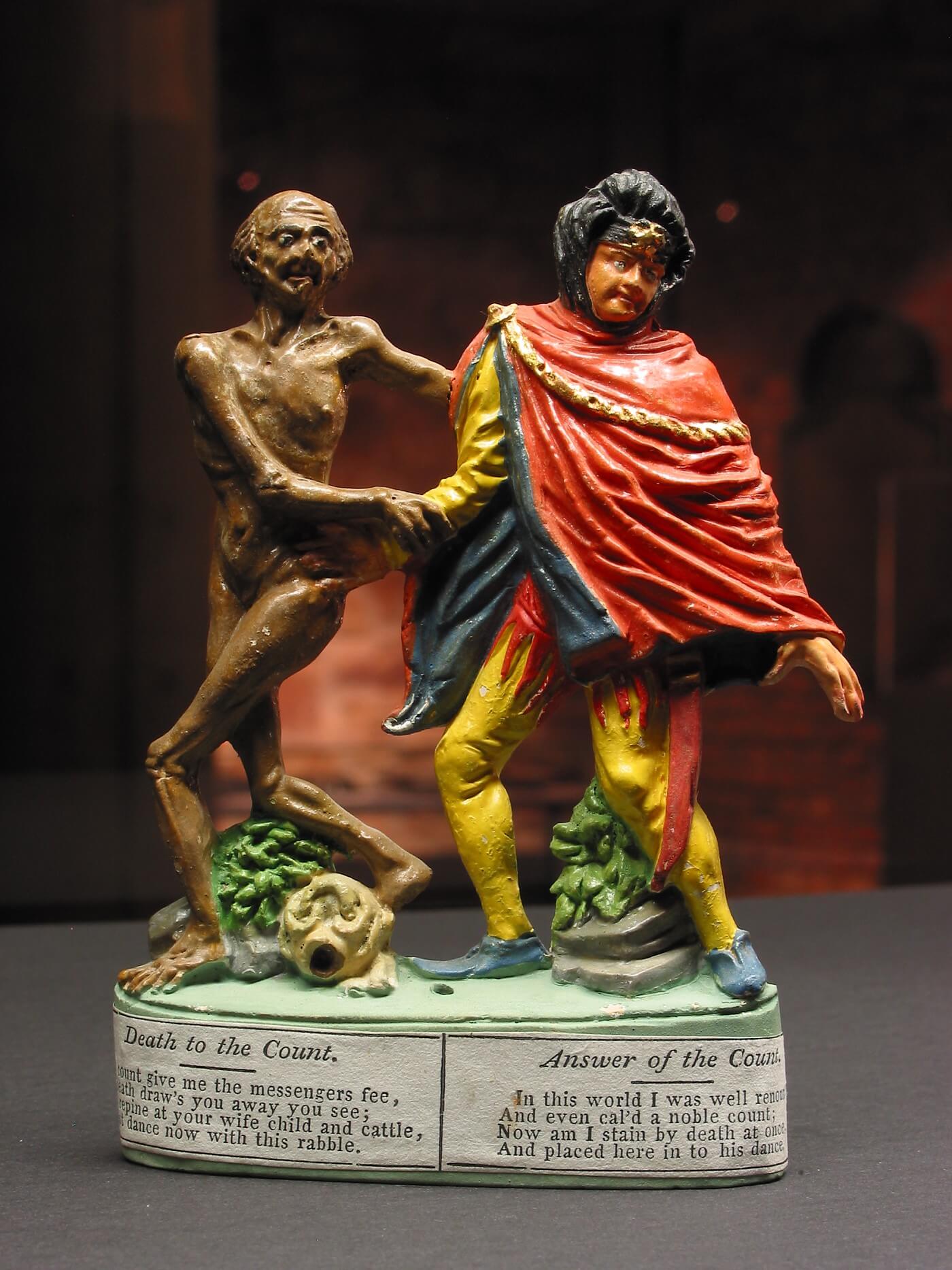
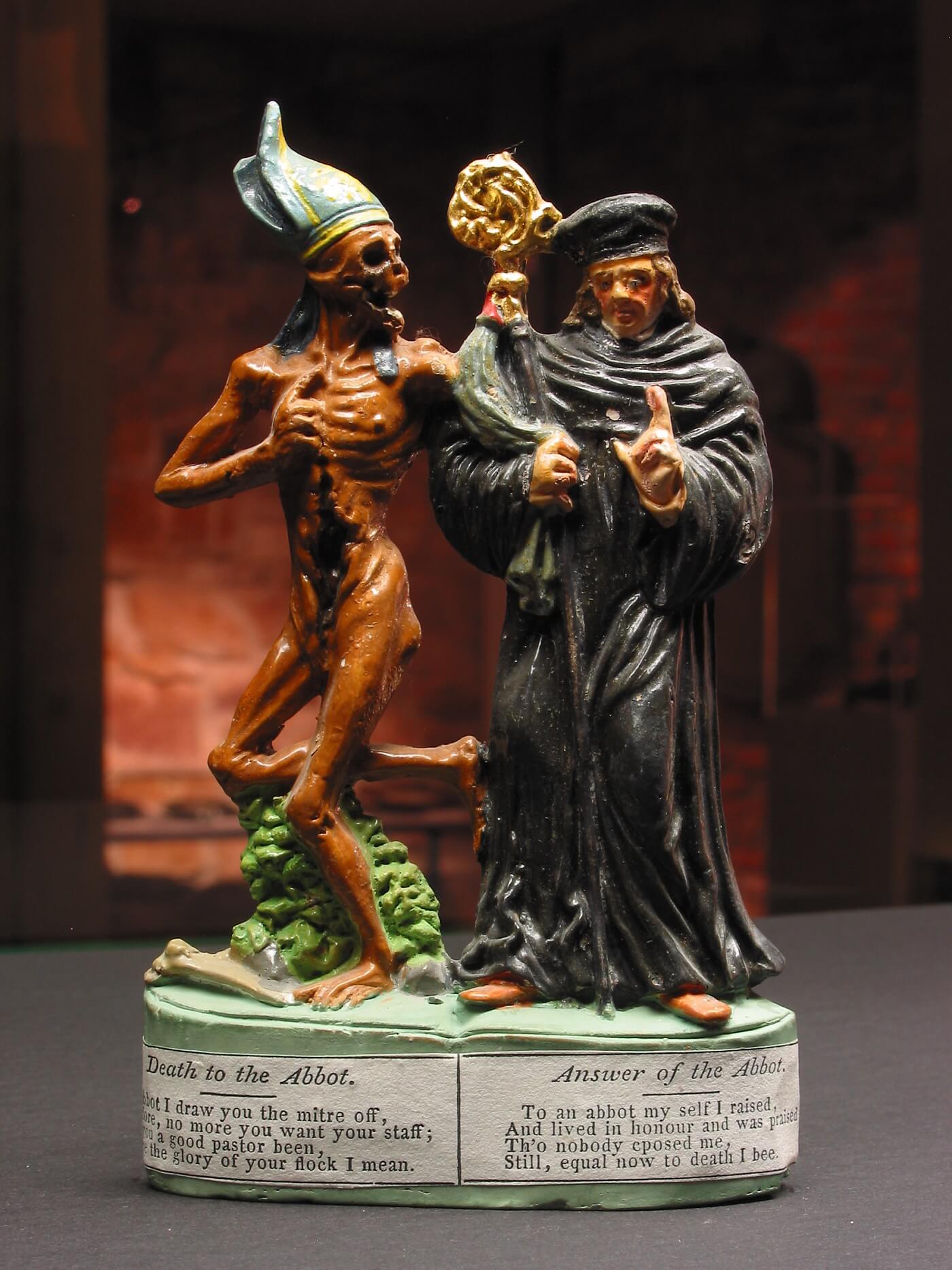
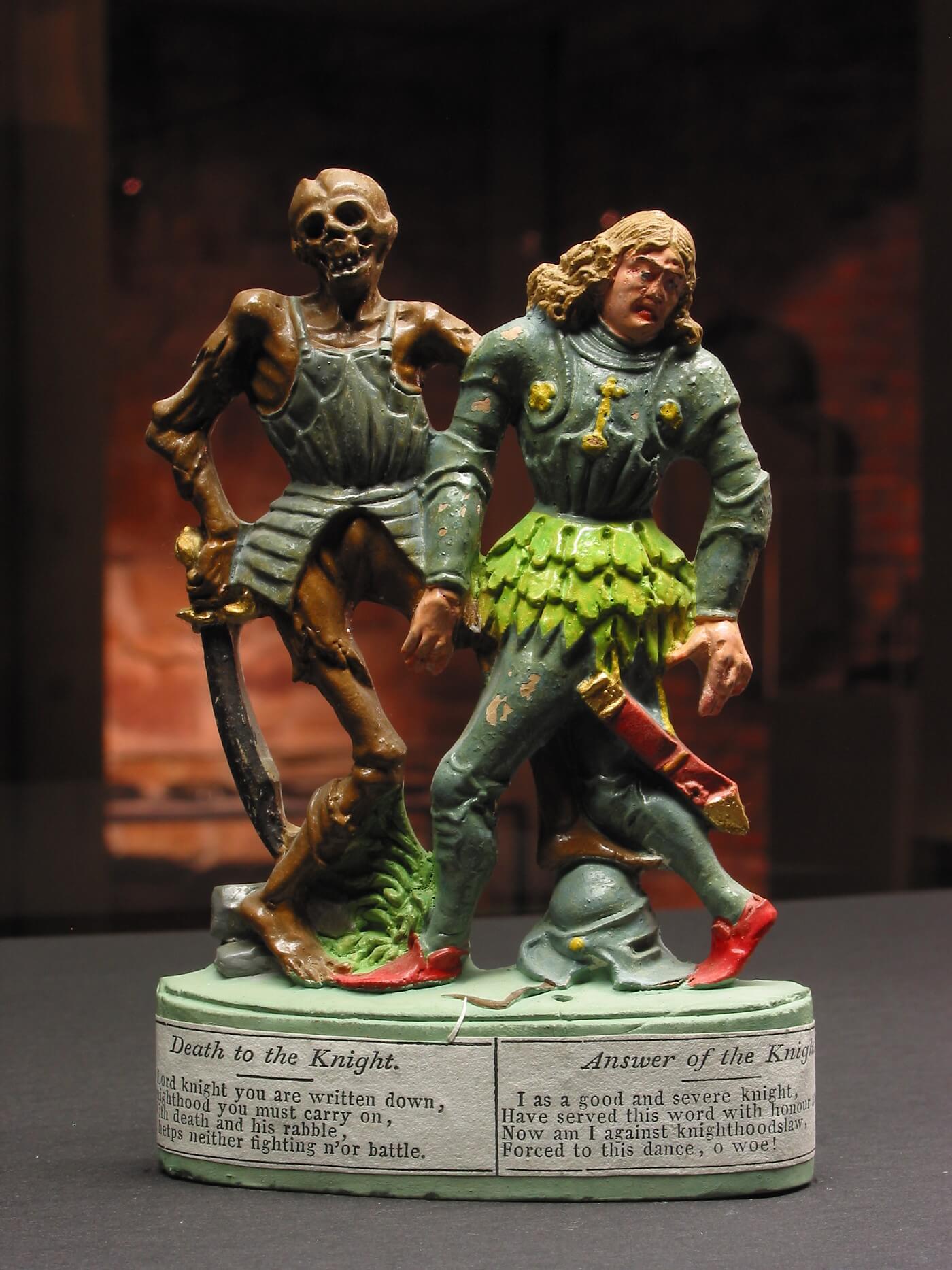
Iconographically striking is the personification of death, which is based less on the depiction of a skeleton and more on an emaciated figure whose body is still covered with skin. The bones, however, are clearly visible, and in some places, the abdomen is open. Death appears highly dynamic, not least because he sometimes carries various musical instruments (e.g., flute, drum, lute), suggesting that he plays for a dance and thus seals the earthly end of his dance partners.

Further information
The figures and their painting were based on a colored version of Matthäus Merian the Elder's famous etching of the Basel Dance of Death. This etching, in turn, was based on a mural, approximately two meters high and 60 meters long, created around 1440 on the cemetery wall of the Dominican monastery in Basel. This monumental Dance of Death was destroyed around 1805 due to its dilapidated condition.
The Zizenhausen figures serve as evidence that interest in him must have remained high even after his death. In miniature, they convey his message as colorfully as they do vividly: spiritual or secular power, and even wealth, are useless in the face of death, for death makes everyone equal – no one can escape it.
Even today, this message is immediately clear, although the power and social structures depicted by the figures no longer correspond to current conditions in the same way. It is striking, however, that these traditional depictions of the Dance of Death, which always attempted to capture and represent a cross-section of society, ultimately bear witness to clichés and stereotypes that sometimes persist even into the present day. The iconographically conveyed generalizations must be seen within the context of their respective time and circumstances. Accordingly, the museum presentation of this series of figures is in no way intended to endorse or propagate one-sided, negatively connoted, or defamatory judgments regarding specific groups of people, professions, or cultures. This applies particularly to the pairs of figures "Death and Jew" and "Death and Heathen." Here, specific iconographic details, intended to ensure their identifiability for medieval and early modern reception societies—as with all representatives of social classes—have, in the long run, contributed to the societal entrenchment of negative attributions of mentality and promoted their perpetuation. Furthermore, a closer look at the text strips reveals, among other things, personal terms (e.g., "death" and "cripple") that represent the then-common language and prevailing linguistic culture, but which are now long outdated. Especially when dealing with other people and groups, it is essential to use value-neutral language and terms to counteract any generalizations—whether regarding appearance, physical condition, ancestry, cultural affiliation, character, customs, etc.—and thus prevent exclusion and defamation.
Anyone interested in research surrounding this unique piece will find information in a variety of specialist literature and also in our catalog “Come what may.”
The figures
The preacher speaks Dan. XII. 23.
And many of them that sleep in the dust of the earth shall awake. Some to everlasting life,
and some to shame and everlasting contempt. And they that, be wise shall shine as the brightness of the firmament, and they that turn many to rigtheousness, as the stars for ever and ever.
The Preacher speaks to Daniel in chapter 12.
Many of those who sleep in the dust of the earth shall awaken again: some shall live eternally, to the other part He will give. A harsh judgment of eternal disgrace: those must rise up, who have other fine accounts, will shine like the light of heaven; but these will be praised, who have led the multitude to piety, will shine like stars in the firmament, and will be eternal without end.
O man be wise, do not despise
Here this figure, of every creature
Death will take, soon or late,
Like the flowers, in the field fades.
O man, consider
And not despised
Here is the figure All Creature
Death takes her
Early morning and late afternoon
Just like the Bluom
It was destroyed in the field.
Death to the Pope.
Come holy father dear to me,
A prime dance you may have seen. Indulgences help's you not away Nor cross nor triple crown I say.
Answer of the Pope.
Holy was I call'd upon earth,
God excepted had I the highest worth, The indulgences greatty rewarded me Now death w'ont spare me as you sce.
Todt to the Pope:
Come, Holy Father, dear man/
You must have a dance with me:
Indulgences will not help you with this.
The double cross and triple crown.
Answer:
I was called holy on earth/
Without God, who leads my state to the highest:
The indulgence would have been very worthwhile for me/
Now death will not spare me.
Death to the Emperor
Sire emperor with your gray beard, your repentance, you have saved for a long time
Therefore d'ont resist, you must away And dance after the tune my whistle does play.
Answer of the Emperor.
My empire I could very well expand To fight and defend against wrong with ease.
Now death has intimately conquered me That I am no more like an emperor, you sec.
Todt to Keyser.
Mr. Keyser with the gray beard/
Euwr Reuw hast jihr zu lang gespar/
Therefore, do not block yourselves/ you must from it/
And dance to my pipe.
The Keyser.
I could greatly increase the kingdom
To fight / fight / defend against injustice:
Now death has overcome me/
That I am not like any Keyser.
Death to the Empress.
I dance to you, lady emperess fine,
Leap after me, the dance is mine,
Of your courtiers you are forsaken,
And by death you are, overtaken.
Answer of the Empress.
My body had much luxurious pride,
I lived as a hight emperor's wife.
Now I am forced to this dance,
All wisdom and spirit comes at once.
I dance for you before Mrs. Keyserin/
Jumping afterwards the dance is mine:
Your courtiers have departed from you.
Death has also crept up on you here.
The Keyserin.
Much lust my proud body has/
I live as a emperor's wife:
Now I have to get to this dance/
All my courage and joy have been taken from me.
Death to the King.
Sire king, your power has come to an end,
I lead you now, here by my hand,
To this great brother's dance,
There one gives you the death's garland.
Answer of the King.
I have lived in great power,
And strive ever, for great honor
Now I am in death's bands.
Much entangled in his hands.
Todt zum Koenig.
Lord King, your power has an end/I lead you here by my hand
To these skinny brothers dance/
They'll give you the death warrant.
The king.
I have lived a tremendous life/
And hovered in high honors:
Now I am in the bonds of death/
He is deeply entangled in his hands.
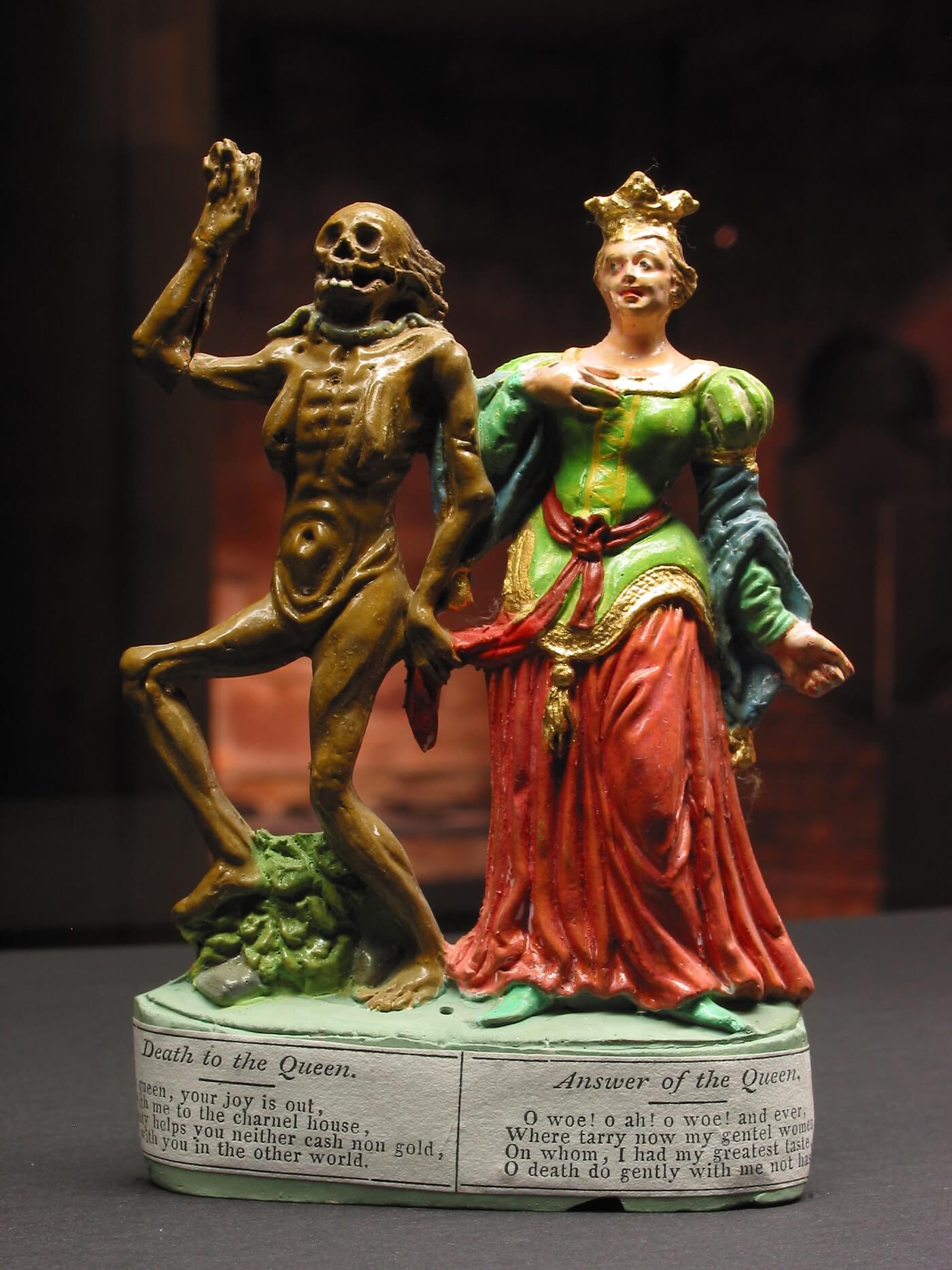
Death to the Queen.
Lady queen, your joy is out,
Leap with me to the charnel house,
No beauty helps you neither cash non gold,
I jump with you into the other world.
Answer from the Queen.
Oh woe! Oh ah! Oh woe! and ever,
Where tarry now my gentel women,
On whom, I had my greatest taste,
O death do gently with me not hasten.
Todt to Queen.
FRaw Koenigin Euwr Frewd is out/
Jump with me into the funeral home/
Neither beauty nor gold nor money will help you.
I'll jump with you into that world.
The Queen.
0 woe and alas / 0 woe and sorrow /
Where is my wife's room now?
With whom I had many friends:
0 Todt thu g'mach / mit mir nicht yl.
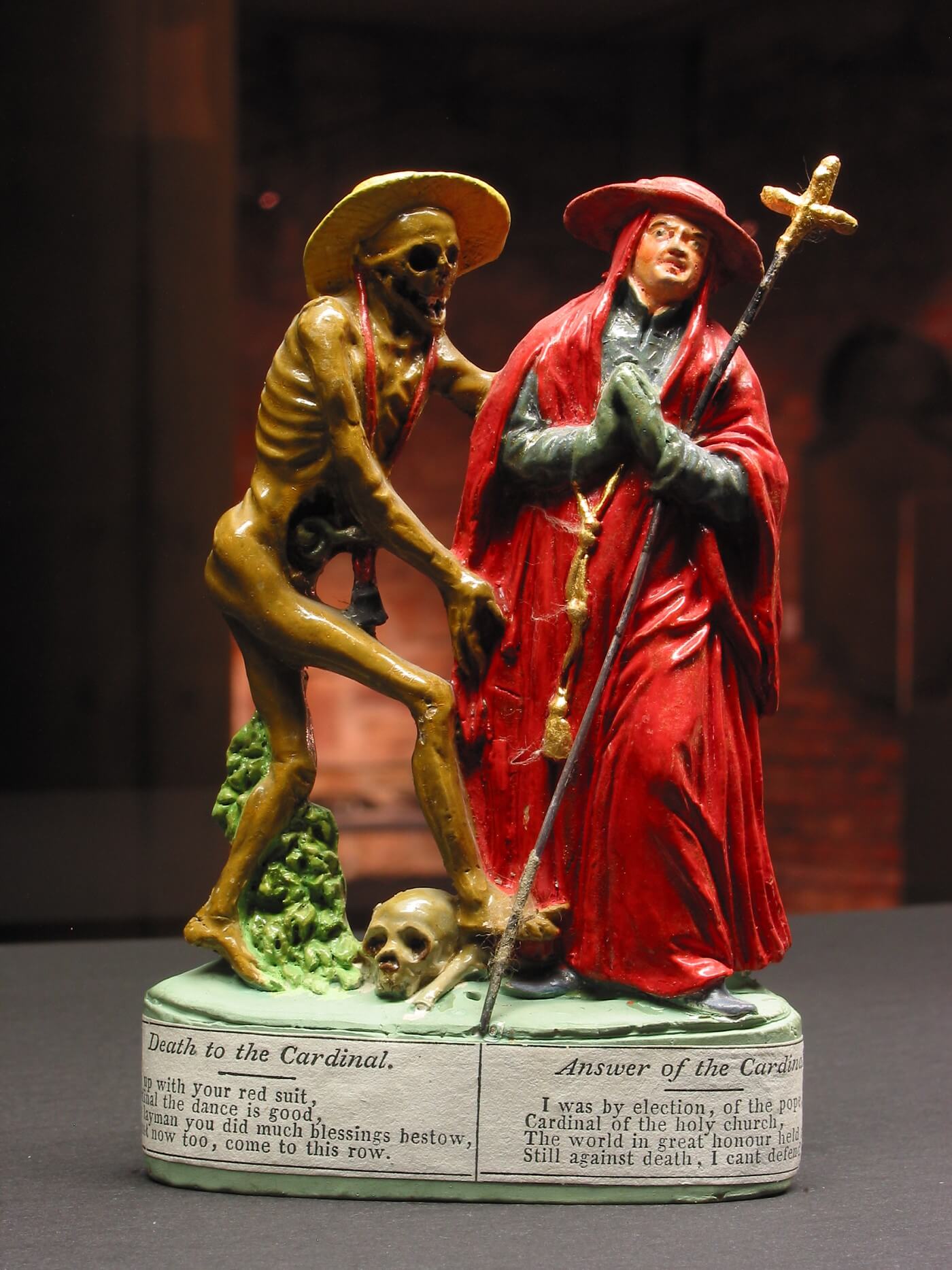
Death to the Cardinal.
Jump up in your red suit,
Sir cardinal the dance is good,
To the layman you did many blessings bestow,
You must now too, come to this row.
Answer of the Cardinal.
I was by election, of the pope,
Cardinal of the Holy Church,
The world in great honor held me,
Still against death, I can't defend myself.
Todt became Cardinal.
Jump up with the red hat/
Mr. Cardinal/the dance is good:
You have blessed the Leyen/
You must also now join the Reyen.
The Cardinal.
I was elected by the Pope
The Holy Church Cardinal:
The world held me in high esteem/
I still cannot defend myself against Todt's.
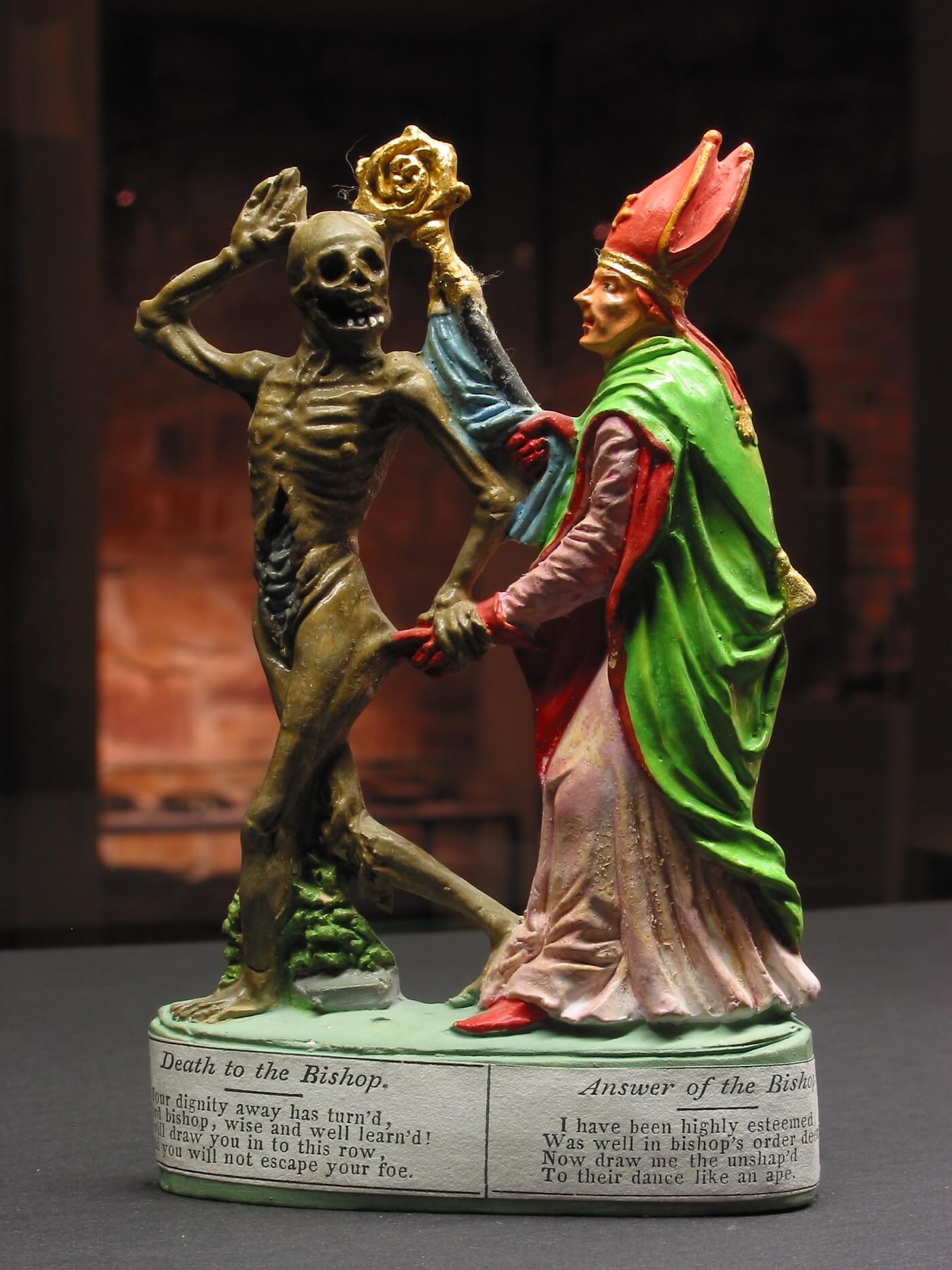
Death to the Bishop.
Your dignity away has turned,
Lord bishop, wise and well learned!
I will draw you in this row,
And you won't escape your foe.
Answer of the Bishop.
I have been highly esteemed,
Was well in bishop's order deemid;
Now draw me the unshap'd
To their dance like an ape.
Todt became bishop.
EVwer Wirde has gone wrong/
Mr. Bisckoff is knowledgeable and well-learned:
I want to draw you into the ranks/
You may not escape death.
The bishop.
I was highly respected/
While I live in the Bishop's order:
Now the uncreated ones are drawing me in
At her dance/as a monkey.
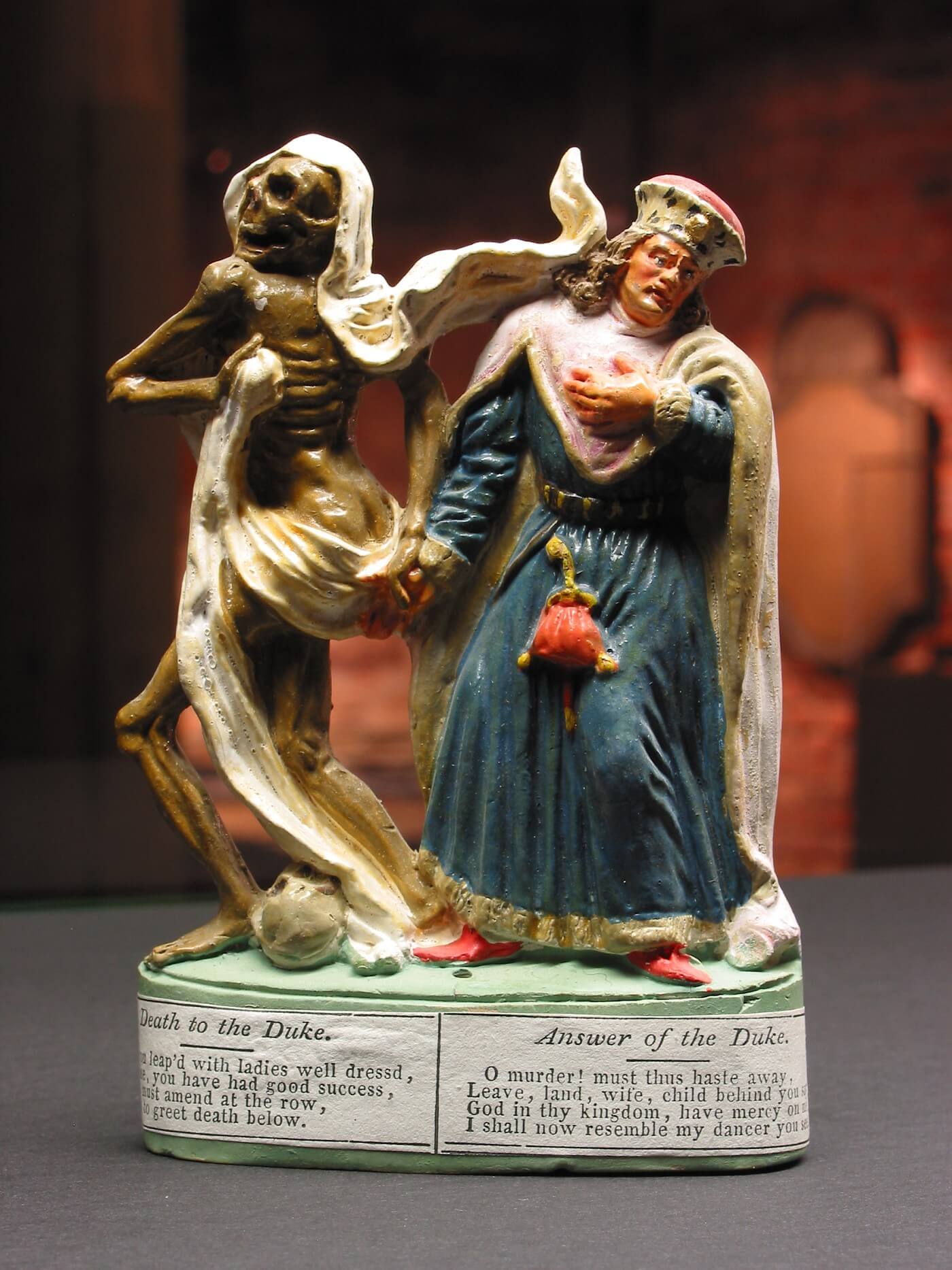
Death to the Duke.
Have you leap'd with ladies well dressed.
Proud duke, you have had good success,
This you must amend at the row,
Welcome, to greet death below.
Answer of the Duke.
O murder! must thus hasten away,
Leave, country, wife, child behind you say,
God in thy kingdom, have mercy on me,
I shall now resemble my dancer you see.
Todt to the Duke.
Have you jumped high with your wife?
Proud Duke, you are well-endowed:
You have to pay for this on the Reyen/
Wol her g'lust Euch die Tod'n zu greessen.
The Duke.
0 Mordt must I so flu dars of it/
Landt/Leut/ Weib Kind dahinden lon:
So God will have mercy in his kingdom/
Now I'm going to my Tentzer.
Death to the Dutchess.
Lady Dutchess be good cheered!
Though you are of noble breed,
High esteem'd upon this earth,
To me you are dear and worthy.
Answer of the Dutchess.
Ah god! the poor sound of the lute,
Must I deal with this horrid man dispute,
Dutchess to day now no more like that,
O anguish, o grief! oh woe, woe
Todt to the Duchess:
FRaw Duchesses are volgemut/
Whether you are already of noble blood/
Highly respected on this earth/
I still love and value you.
The Duchess.
Oh God of the poor lute sound/
Do I have to deal with the grieving process?
Today Duchess and nevermore/
Oh fear and distress/ oh woe, oh woe.
Death to the Count.
Lord count give me the messengers fee,
Bitter death draws you away you see;
Do not repine at your wife child and cattle,
You must dance now with this rabble.
Answer of the Count.
In this world I was well resounded,
And even called a noble count;
Now am I stained by death at once,
And placed here in his dance.
Todt zum Graffen:
Mr. Graff, give me the bread.
Bitter death will draw you to this place:
Do not let yourselves be robbed, wife and child/
You must dance with this G'sindt.
The Count.
In this world I was known/
One of them was named Edler Graff:
Now I am felled by death/
And placed here for this dance.
Death to the Abbot.
Sir abbot I draw you the miter off,
Therefore, no more you want your staff;
Have you been a good pastor?
You are the glory of your flock I mean.
Answer of the Abbot.
To an abbot of myself I raised,
And lived in honor and was praised,
Th'o nobody cposed me,
Still, right now to death I bee.
Todt zum Apt.
Mr. Apt, I'll take your money/
Therefore, the staff is no longer of use to you:
Have you been a good shepherd?
Here your work/ the honor will be yours.
The Apt.
I have risen up as an apt/
And lived long in high honors:
No one is standing up against me either/
Nevertheless, I am like death.
Death to the Knight.
Lord knight you are written down,
Knighthood you must carry on,
With death and his rabble,
It's neither fighting nor battle.
Answer of the Knight.
I as a good and severe knight,
Have served this word with honor and might,
Now am I against knighthoodslaw,
Forced to this dance, oh woe!
Death to knighthood.
Mr. Knight, your names are written on/
Knighthood they must practice/
With Death and his servants/
Neither arguing nor fighting will help.
The knight.
I, as a strict knight, am good
I have served the world with great courage:
Now I am against knightly orders
I was forced to dance this dance.
Death to the Lawyer
No fund helps here n'or to court,
Neither delay nor appeal,
Death forces all genders,
Both church and civil law defnnder.
Answer from the Lawyer.
From God all laws are given to us,
As one will be easy to find in books.
No lawyer shall bend them,
Hate the lies and defend the truth.
Todt became a lawyer.
No amount of searching or hoping will help.
No elevator/ or appeal:
Death compels all genders/
This includes both spiritual and secular law.
The lawyer.
All rights have been given by God/
How to find them in the books:
No lawyer should bend the same/
Hate lies/love the truth.
Death to the Senator.
Have you been a lord of the town,
Who in the senate had his worth
Have you well advised is good for you
Your hat now drawing off I do.
Answer of the Senator.
I have enjoyed day and night
That the best of the common might be considered,
Seek the glory and profit of poor and rich,
What I fancied would be good for the majority I wish.
Todt became a councillor.
Are you a lord of the city?
The one that was used in the Rhat:
Have you all the best? Are you well?
He'll also take your hat off.
The councilman:
I worked hard day and night/
That the common good be considered:
Seek benefit and honor for rich and poor alike.
What seems good to me / makes me more.
Death to the Canon.
Sir quire monk have you been singing
Much sweet song, in your choir
Hear now the sound of the pipe
Announces your death will be ripe.
Answer of the Canon.
I sang as a canon free
Of voices many of melody,
The pipe of death not equal bee,
There fore so much it frightened me.
Todt became a canon.
Mr. Choir Priest, you sang before
Much sweet singing in your choir:
So notice the sound of the whistle/
Announce your death.
The Canon:
I sang freely as a canon
Some voices melody/
The death whistle does not affect the person equally/
She scared me so much.
Death to the Doctor.
Sir doctor, behold the anatomy
If it be well done on me,
Many one where dispachid by thee,
Who even now resembles me.
Answer from the Doctor.
I have with my viewing the water
Helped both mother and father;
Who is now viewing my water prayer?
As I must now go away with death.
Todt to the Doctor.
Mr. Doctor b'schawt the Anatomy
To me/ whether she is properly made:
Then you also executed some/
The same as I see it now.
The Doctor.
I watched with my water
Both men and women helped:
Who will now show me the water myn/
I must now go there with death.
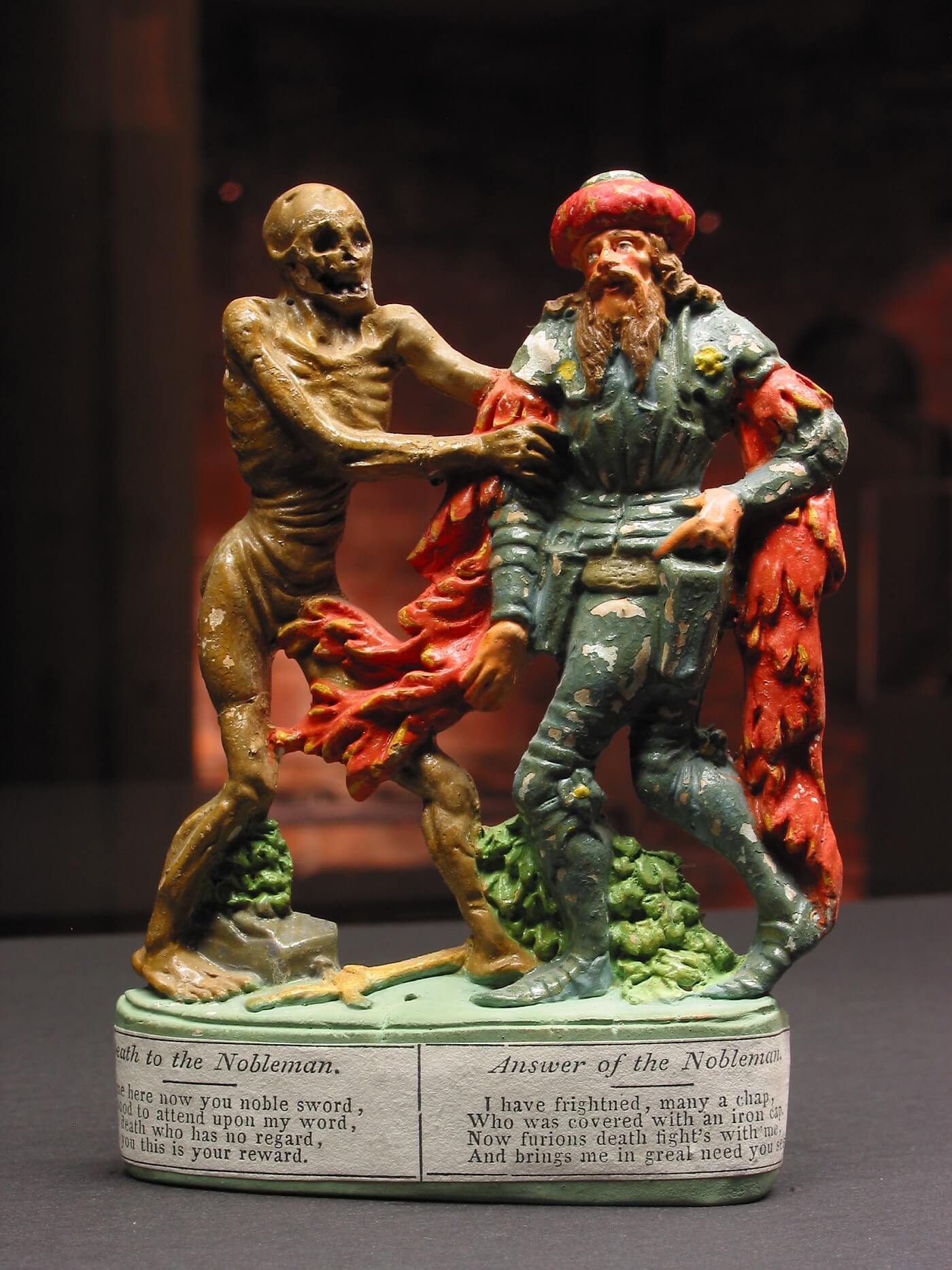
Death to the Nobleman.
Come here now from your noble sword,
Manhood to attend upon my word,
With death who has no regard,
Bless you, this is your reward.
Answer of the Nobleman.
I have frightened, many a chap,
Who was covered with an iron cap;
Now furious death fight's with me,
And brings me to Greal need you see.
Death to nobleman.
NVn come here your noble sword/
Jhr muesset hi der Mannheit pflegen:
With death, which spares no one,
Bless you/ so you will be rewarded.
The nobleman.
I have scared quite a few men/
The one covered by armor:
Now grim death fights with me/
And it puts me in great distress.
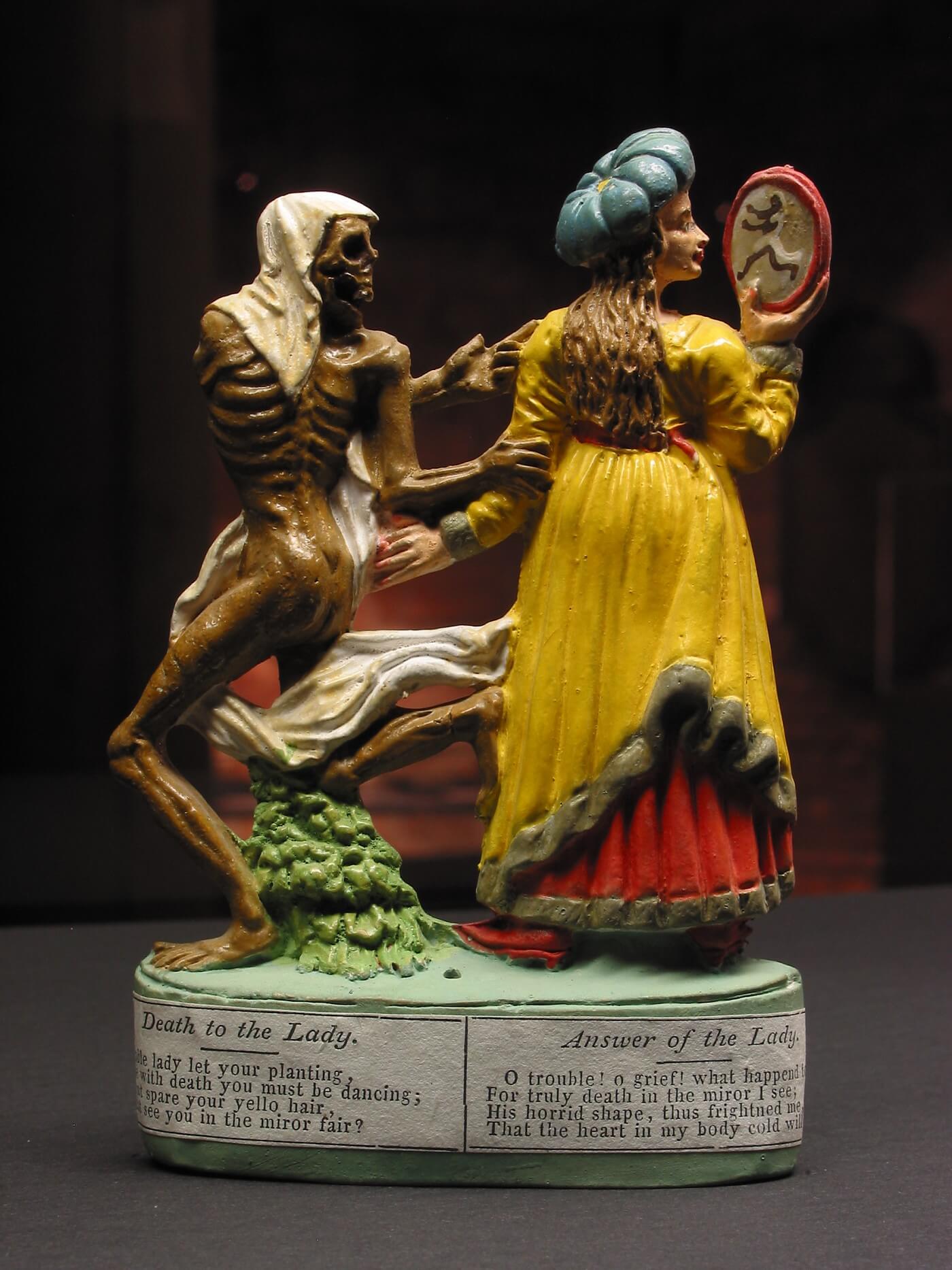
Death to the Lady.
Noble lady, let your planting,
Here with death you must be dancing;
I don't spare your yello hair,
What do you see in the mirror fair?
Answer of the Lady.
Oh trouble! oh grief! what happened to me?
For truly death in the miror I see;
His horrid shape, thus frightened me,
That the heart in my body will be cold.
Todt to the noblewoman.
Let everyone plant from the nobility of Fraw/
You must dance with me here now/
I don't already know your yellow hair:
What do you see in the mirror, clear?
The noblewoman.
O fear and distress, how has it befallen me!
I saw death in the mirror:
I was frightened by its gruesome form/
My heart feels cold inside.
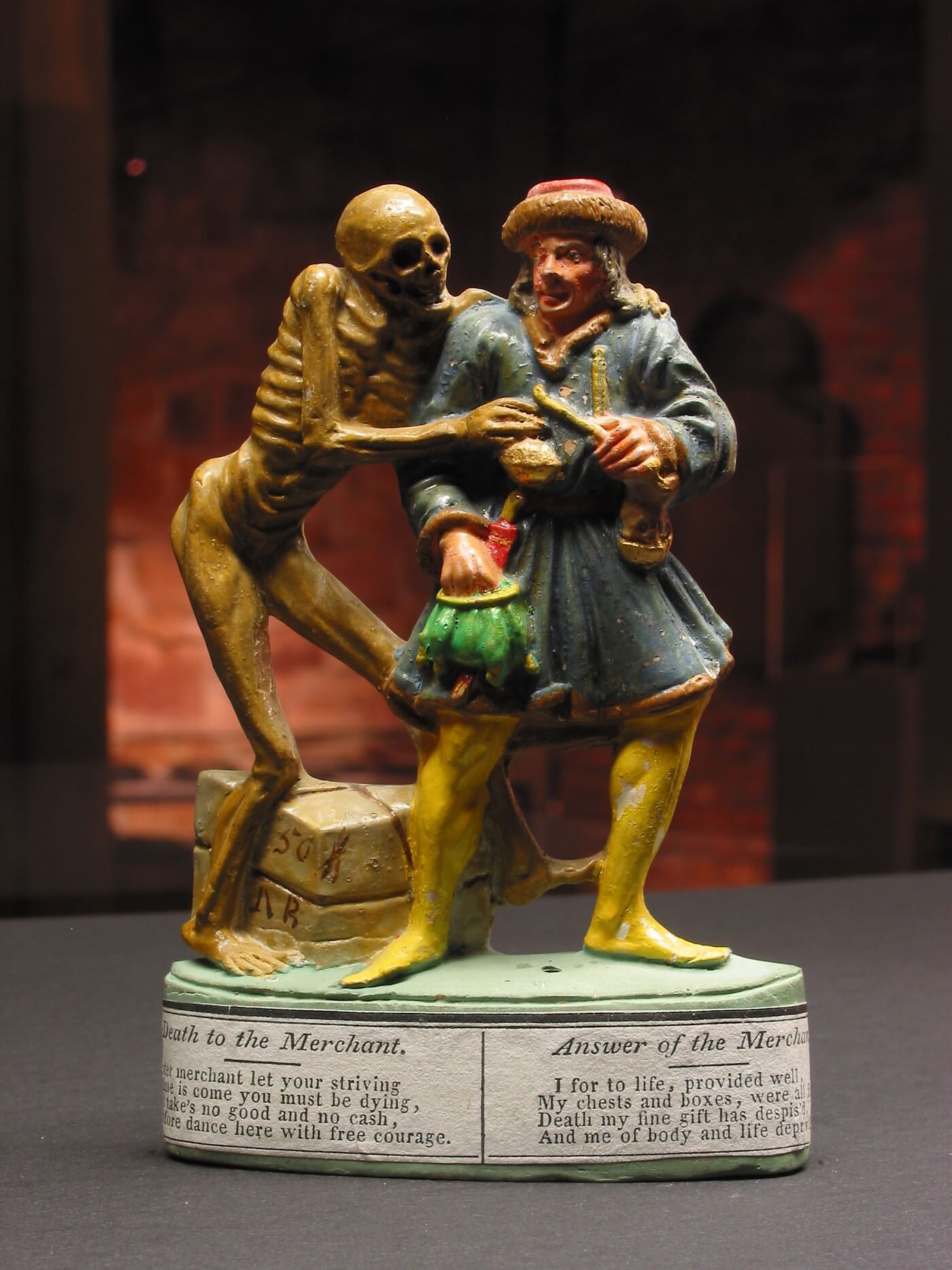
Death to the Merchant.
Mister merchant let your striving
For time has come vo must be dying,
Death takes no good and no cash,
Therefore dance here with free courage.
Answer from the Merchant.
I for life, provided well,
My chests and boxes were all full,
Death my fine gift has despisd,
And me deprived of body and life.
Todt to Kauffman.
Mr. Kauffman let you advertise/
The time is here/ you must die:
Death takes neither money nor possessions:
Now dance here with free courage.
The merchant.
I have provided for myself to live well/
Chests and boxes were full/
Death has consumed my gift/
And it cost me my life.
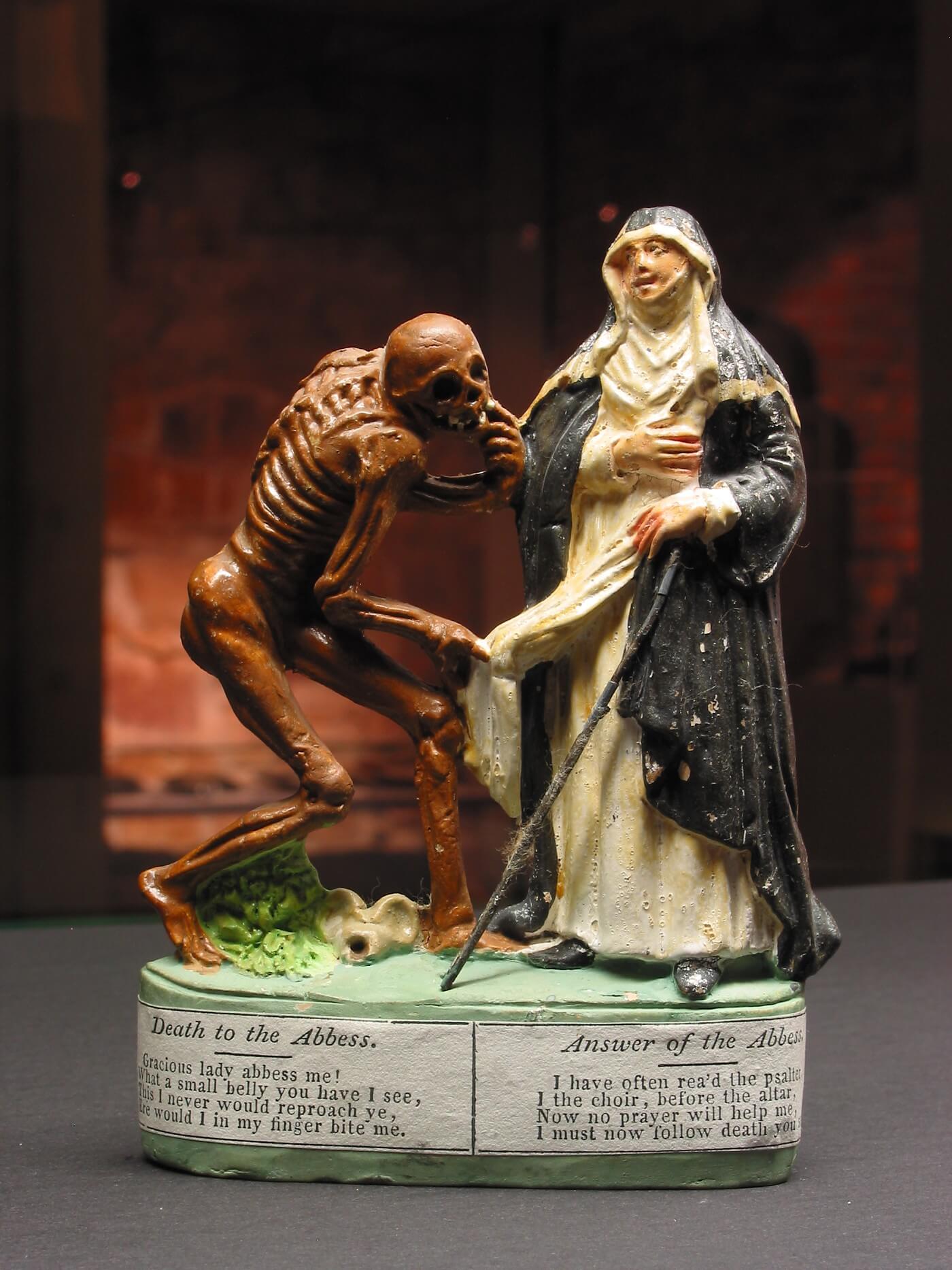
Death to the Abbess.
Gracious lady abbess me!
What a small belly you have I see,
This I never would repeat ye,
Ere would I bite me in my finger.
Answer of the Abbess.
I have often read the psalter,
I the choir, before the altar,
Now no prayer will help me,
I must now follow death you see.
Todt to the Episcopal see.
GNedige Fraw Epiptissin rein/
How did you get such a small belly?
But I don't want to dissuade you from that/
I was going to kick myself anyway.
The Epissis:
I read from the Psalter
In the choir in front of the altar:
Now, if anyone wants to help me, there's no bedding here/
I must also kick death here.
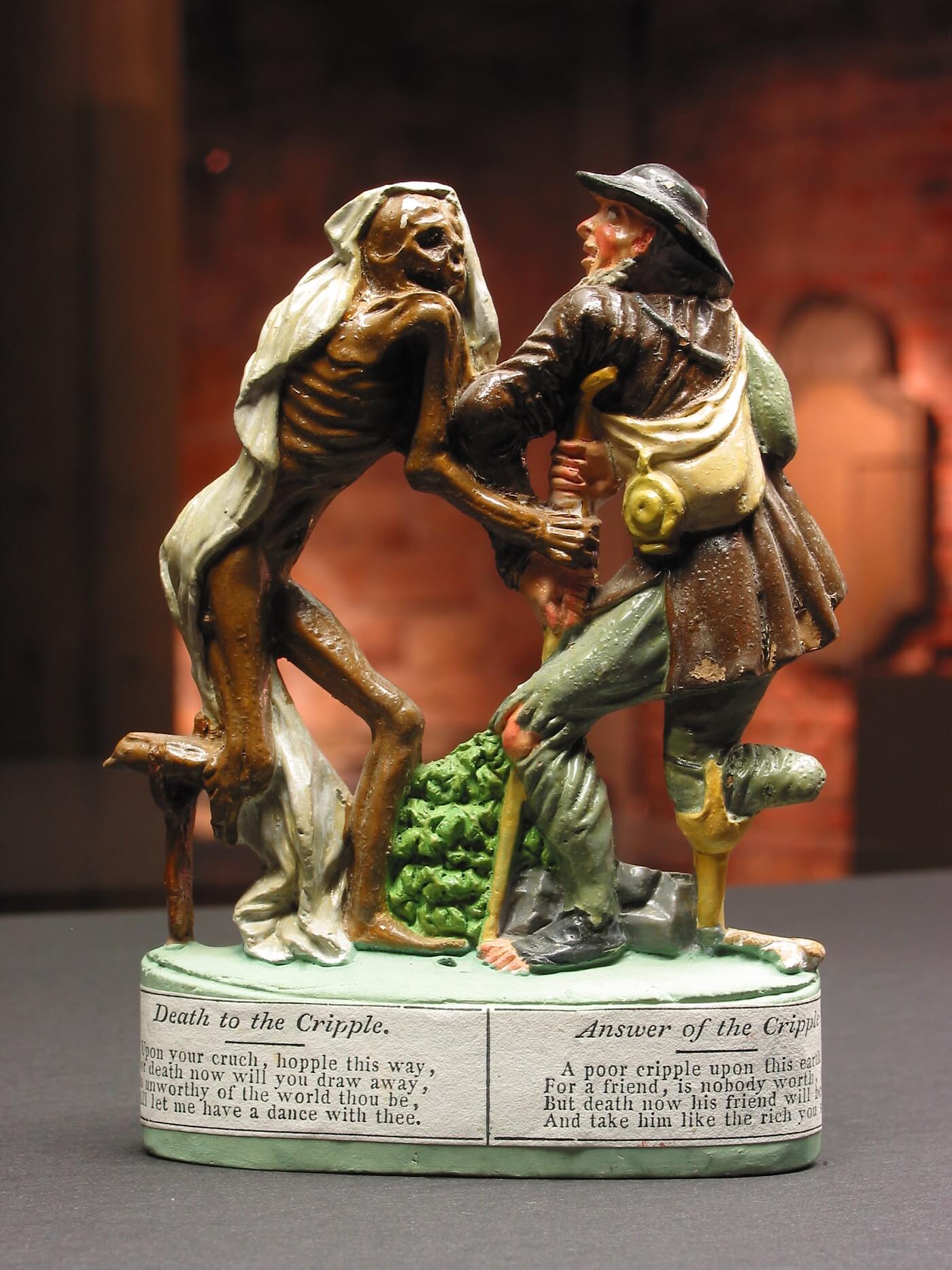
Death to the Cripple.
Upon your crunch, hop this way,
For death now you will draw away,
As unworthy of the world thou be,
Still let me have a dance with you.
Answer of the Cripple.
A poor cripple upon this earth
For a friend, nobody is worth
But now his friend will die
And take him like the rich you see.
Todt zum Krueppel.
Hincke, bring on your crutches too!/
Death wants to jerk you away now:
You are very foreign to the world/
Come join me at my dance here.
The cripple.
A poor cripple here on earth/
No one waits for a friend:
But Death wants to be his friend/
He takes him with the rich man.
The example of this pair of figures illustrates that when examining historical Dances of Death, one inevitably encounters personal terms that reflect the prevailing language and culture of the time. For instance, while the term "cripple" is still known and ingrained in everyday language, its use carries negative connotations and should therefore be avoided. The term "cripple" no longer refers solely to a person with a disability, but is also used to describe an unpopular individual, thereby unjustly ascribing a disability to them. "Cripple" is thus tantamount to an insult. The negative value judgments conveyed by this term are rooted in the precarious treatment of disabled people in earlier centuries. Well into the modern era, people with disabilities were considered social outcasts who often led lives under extremely difficult conditions. This is also reflected in the dialogue, where Death declares the cripple unworthy of the world , making the dance with him a particularly alluring prospect.
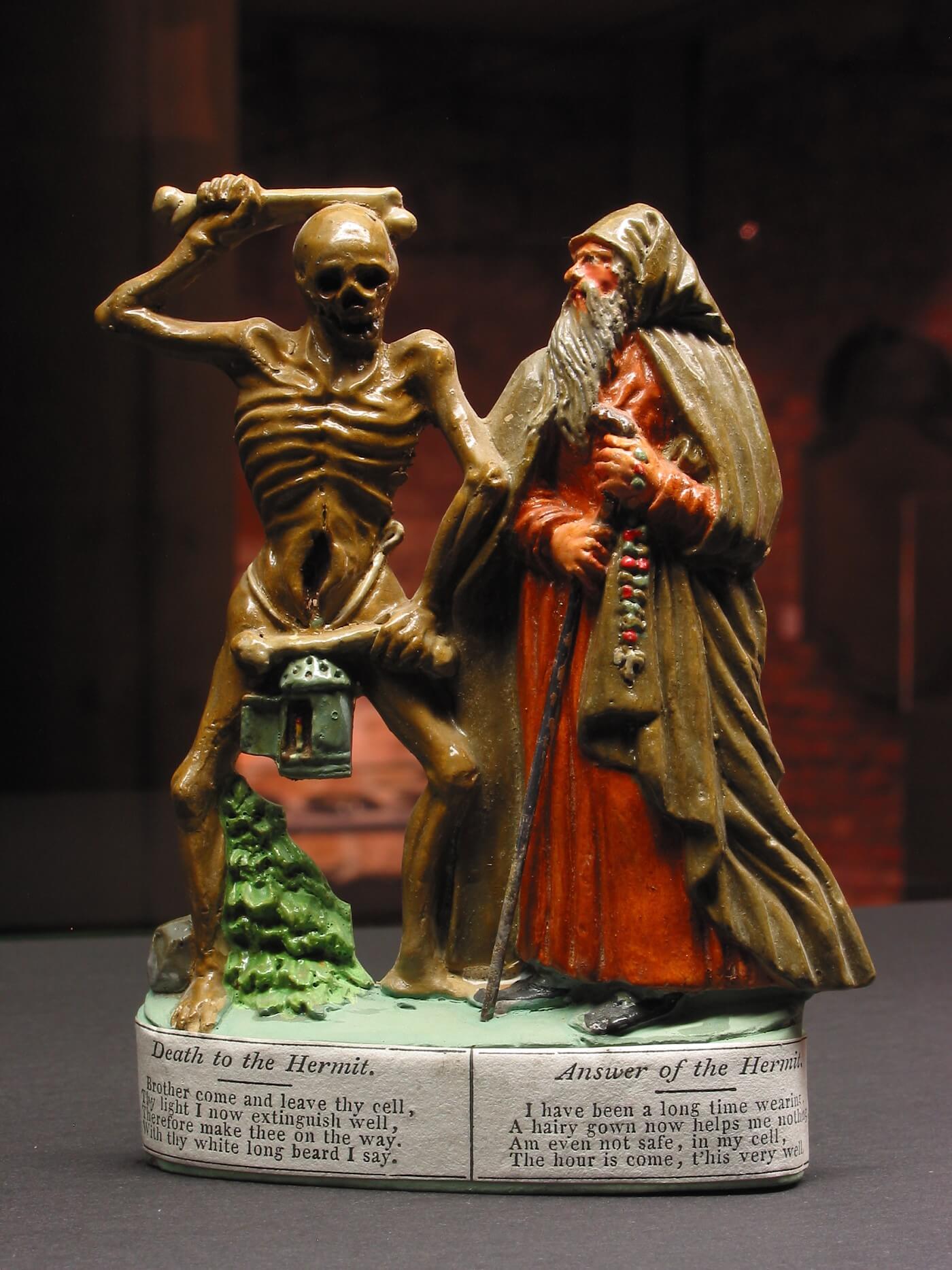
Death to the Hermit.
Brother come and leave thy cell,
Thy light I now extinguish well,
Therefore make thee on the way,
With thy white long beard I say.
Answer of the Hermit.
I have been wearing it for a long time:
A hairy gown now helps me nothing,
I'm not even safe in my cell.
The hour has come, t'his very well.
Todt zum Waldbruoder:
Brother, come out of your dungeon/
Hold still, I'll put out your light.
So come with me on the journey/
With your long white beard.
The forest bruoder.
I wore it for a long time
A hairy dress/ helps me now not:
I'm not sure in my Clauß/
The hour is here/ my bed is out.
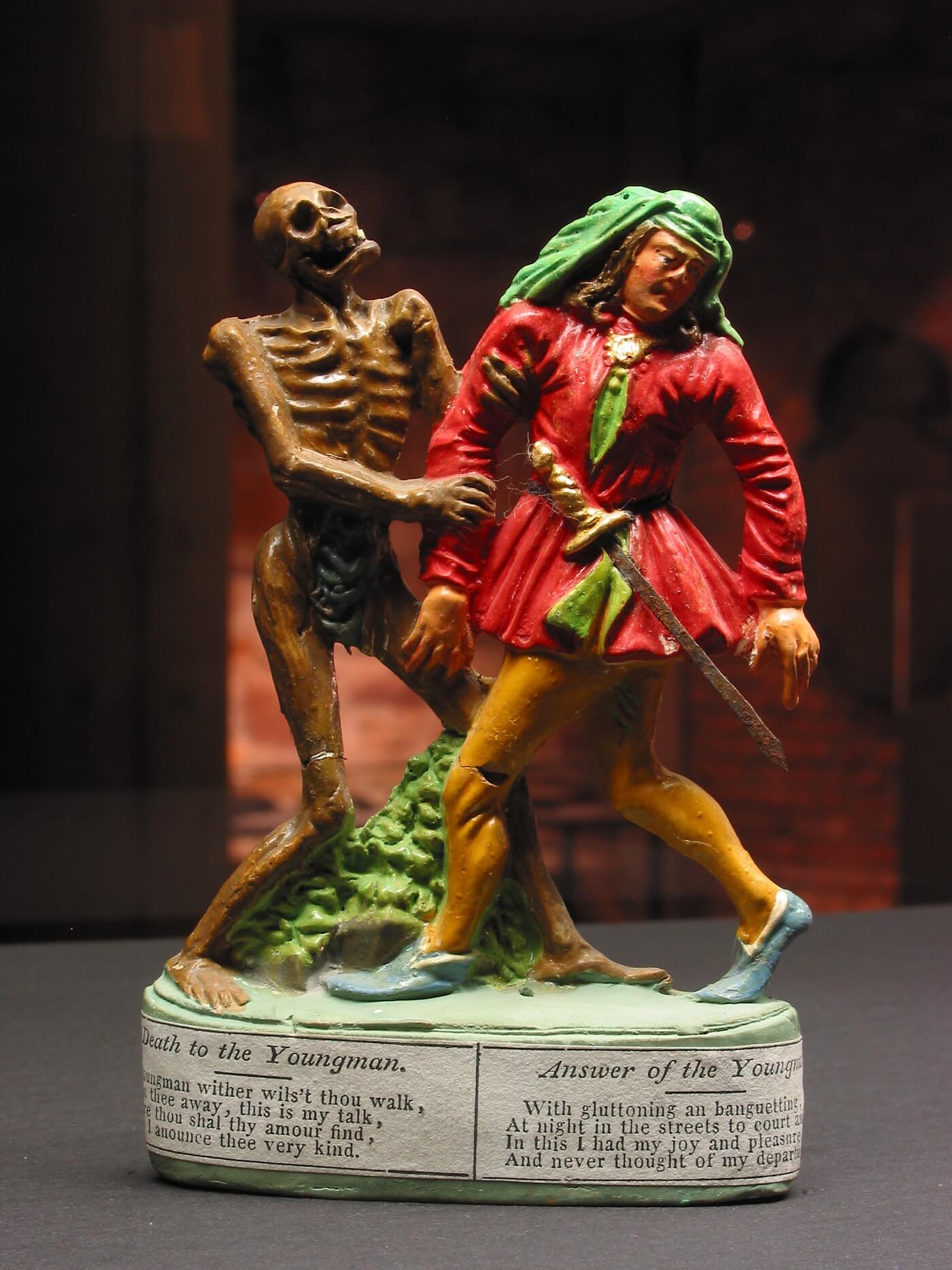
Death to the Youngman.
Youngman wither wils't thou walk,
Turn thee away, this is my talk,
There thou shal thy amour find,
This I announce thee very kind.
Answer of the Youngman.
With gluttoning and banguetting,
At night in the streets to court and sing,
In this I had my joy and pleasure,
And never thought of my departure.
Todt to the young man:
Young man, where do you want to go?
I want to lead you down a different path/
Alda wirstu dein Bulschafft finden/
I do this to you now and announce it.
The young man:
With feasting/ gorging and reveling/
Courting at night in the streets/
In that I had my courage and joy/
He gave little thought to the farewell.
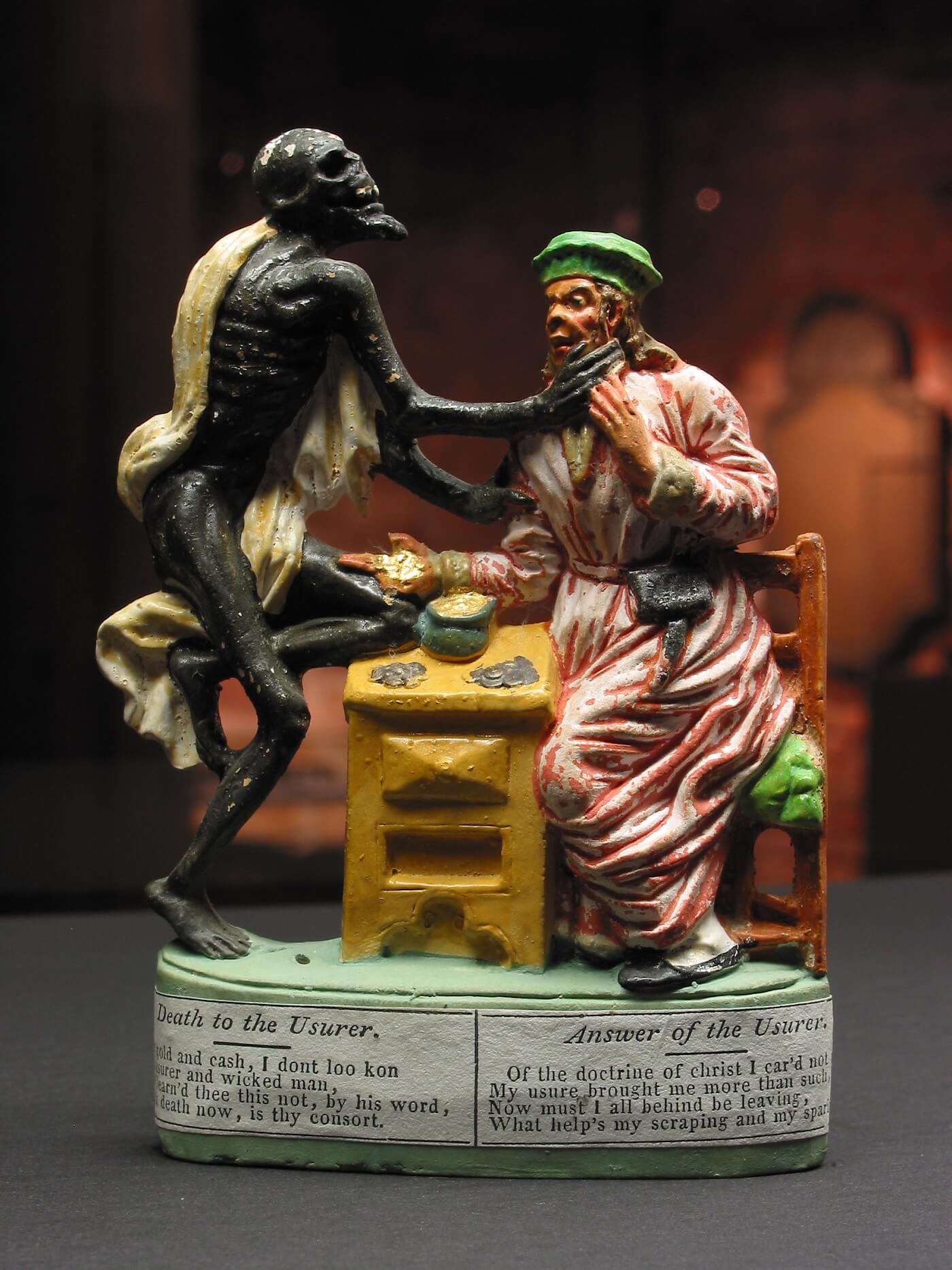
Death to the Usurer.
Thy gold and cash, I don't lose money,
Thou usurer and wicked man,
Christ learned thee this not, by his word,
A black death now, is thy consort.
Answer of the Usurer.
Of the doctrine of Christ I cared not much,
My usure brought me more than such,
Now I must all be leaving behind,
What helps's my scraping and my sparing.
Todt to the usurer:
Your gold and worth do not affect me/
You usurer and godless man:
Christ did not teach you that/
A black death is your companion.
The usurer:
I don't ask much about Christ's teachings/
My usury brought me much more:
Now all suffering remains behind/
What good is my scraping and my skinning?
The term "usurer" refers to a person who offers a particular service or goods at a grossly inflated price in order to maximize their profit. In earlier centuries, however, this term was primarily used in connection with expensive loans, often accompanied by so-called usury. Interest was forbidden in the Middle Ages. Christians who traded on interest and earned money in this way were considered sinners. However, the practice of trading on interest was virtually unavoidable because the demand for capital income in various sectors was constantly increasing. This demand was met by entrusting money lending to Jews. They were considered unbelievers and were therefore exempt from the prohibition against usury. In this pair of characters, the usurer is not explicitly identified as Jewish. Rather, the point is to symbolize the transgression of a divine commandment. The dialogue reinforces this by the usurer openly confessing his disinterest in Christ's teachings. Against this background, it is not the good death in bright colors that seals his life, but the black-framed death, which stands for plague and eternal damnation.
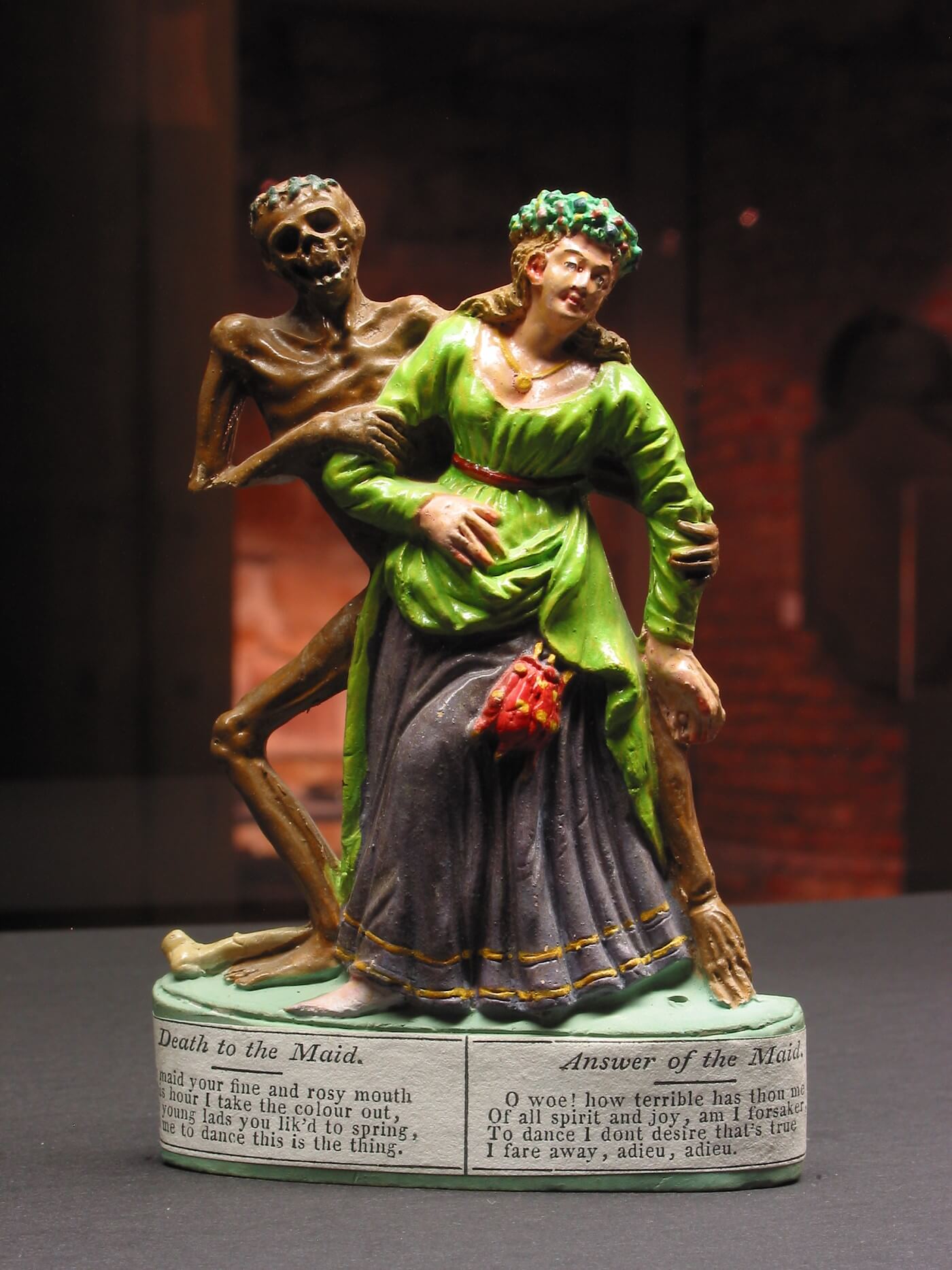
Death to the Maid.
Ah maid your fine and rosy mouth
At this hour I take the color out,
With young lads you like to spring,
With me to dance this is the thing.
Answer of the Maid.
Oh woe! how terrible has thou taken me,
Of all spirit and joy, am I forsaker,
To dance I don't desire that's true
I'm going away, adieu, adieu.
Todt to the Virgin:
Oh maiden, your red mouth
Turns pale now at this hour:
They like to jump with young boys/
You must have a trial dance with me.
The virgin:
O Wee/ how horribly you captured me/
All my courage and joy have vanished:
I no longer feel like dancing/
I'm going there/ bye/ bye.
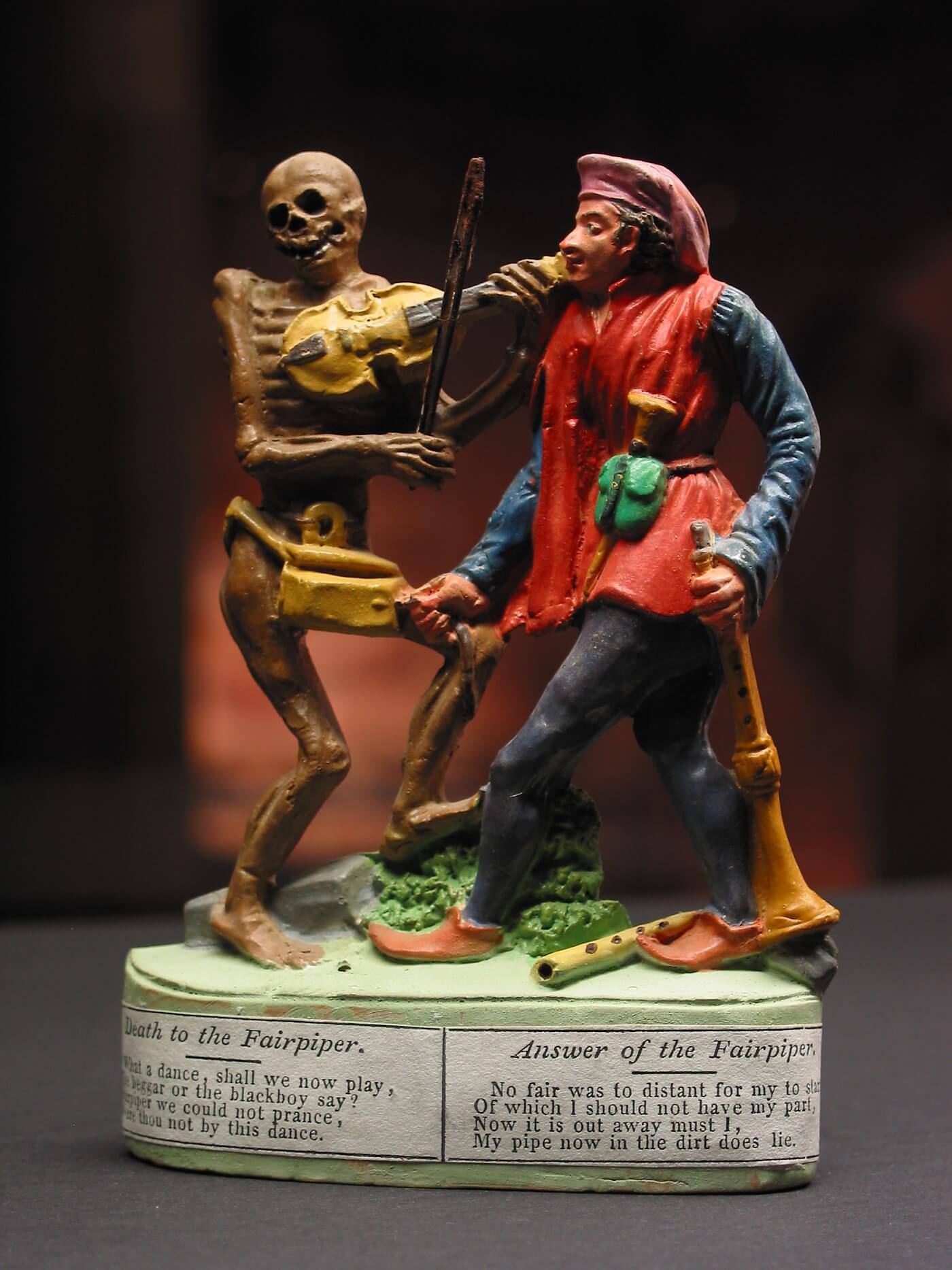
Death to the Fairpiper.
What a dance, shall we now play,
The beggar or the blackboy say?
Fairpiper we couldn't prance,
Were thou not by this dance.
Answer of the Fairpiper.
No fair was too distant for me to start,
Of which I should not have my part,
Now it is out away must I,
My pipe now in the dirt does lie.
Todt to the Kirbepfeiffer:
What kind of dance do we want to have?
The beggar or black boy/
My Kirbehans/ game wouldn't be quite/
You wouldn't be at this dance either.
The Kirbepfeiffer:
No fair was half too far for me/
What I didn't have, my loot brought:
Now it's over/ I have to leave with necessity/
The whistle fell into my dung.
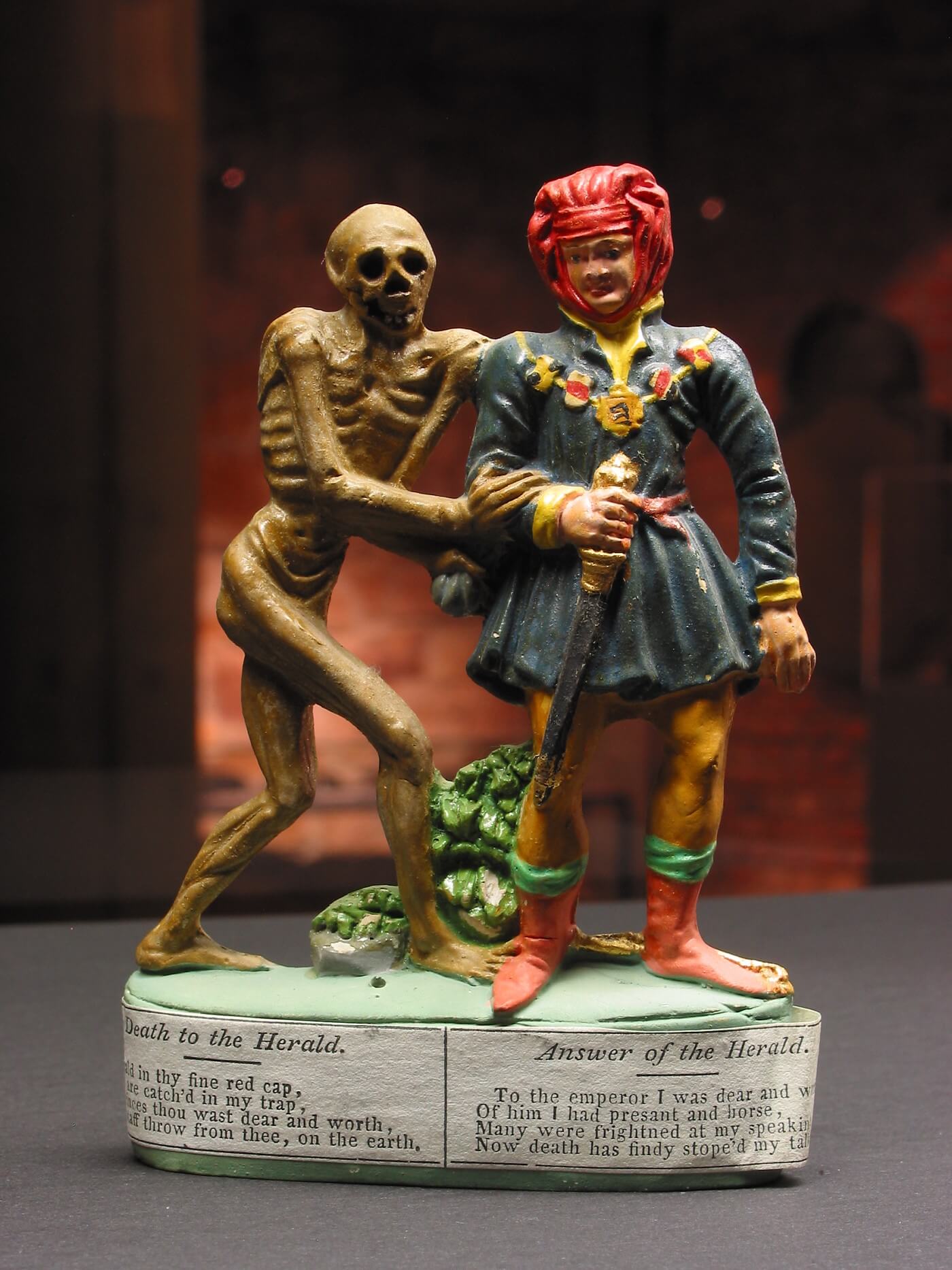
Death to the Herald.
Herald in thy fine red cap,
You are caught in my trap,
By princes thou wast dear and worth,
Thy staff throw from thee, on the earth.
Answer of the Herald.
To the emperor I was dear and worth,
Of him I had presant and horse,
Many were frightened at my speaking.
Now death has stopped my talking.
Death to the herald:
Herald in your red caps/
Now I have to catch you too:
You were dear and worthy to the princes.
Throw your staff down to the ground.
The Herald:
The emperor loved me dearly.
From him I received a gift and a horse:
My speech has frightened some people/
Now death has put an end to my chatter.
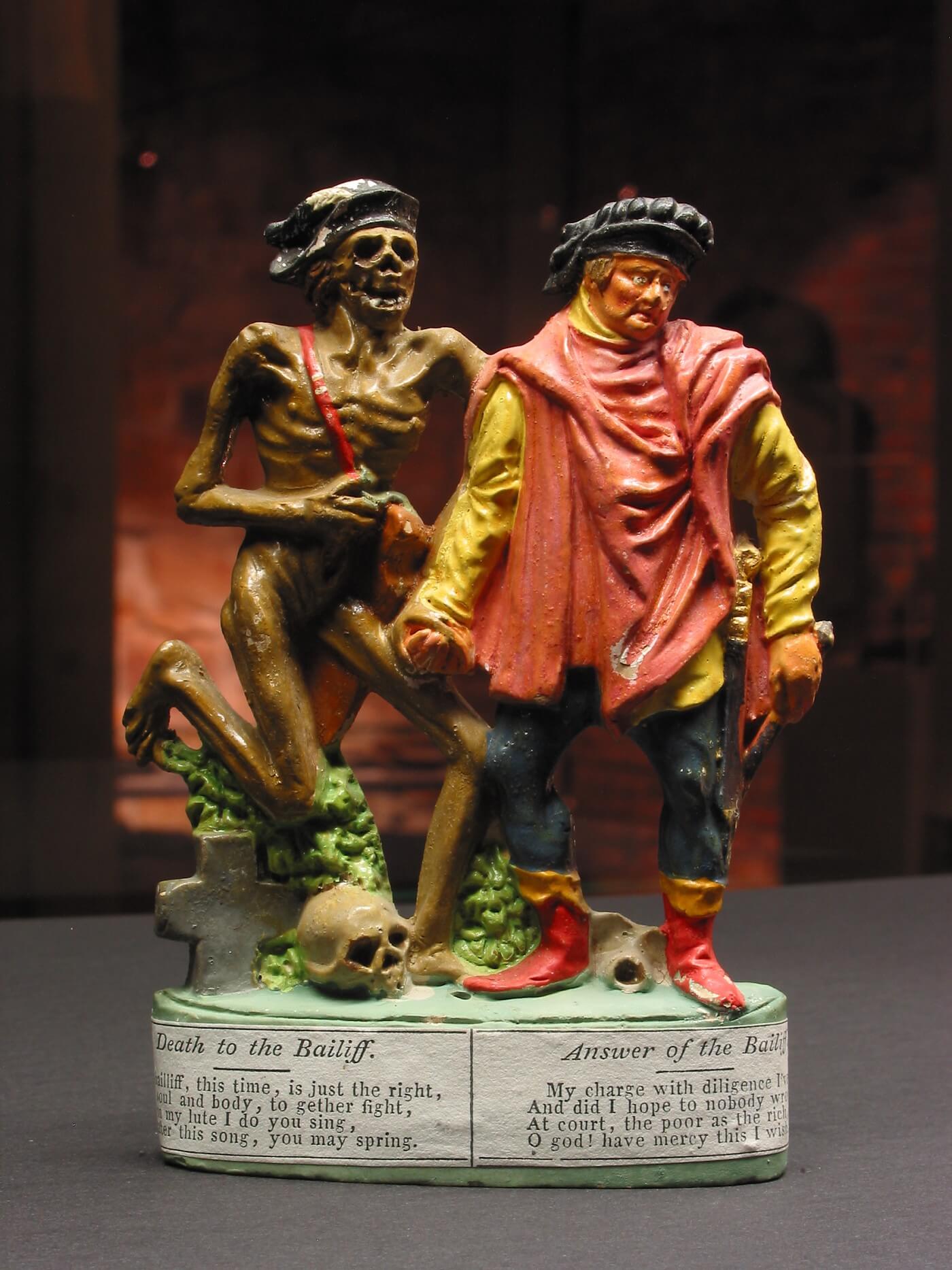
Death to the Bailiff.
Up bailiff, this time, is just the right,
That soul and body, thogether fight,
This on my lute I do you sing,
And after this song, you may spring.
Answer of the Bailiff.
My charge with diligence I've done
And did I hope to nobody wrong,
At court, the poor as the rich,
Oh god! have mercy this I wish.
Todt to the mayor:
Mr. Mayor, get up / then it is time/
That body and soul struggle together/
I sing that on the lyre/
You may follow the little song.
The mayor:
I diligently performed my duties.
I hope no one has been wronged:
At the court, the rich as well as the poor/
O God, have mercy on me.
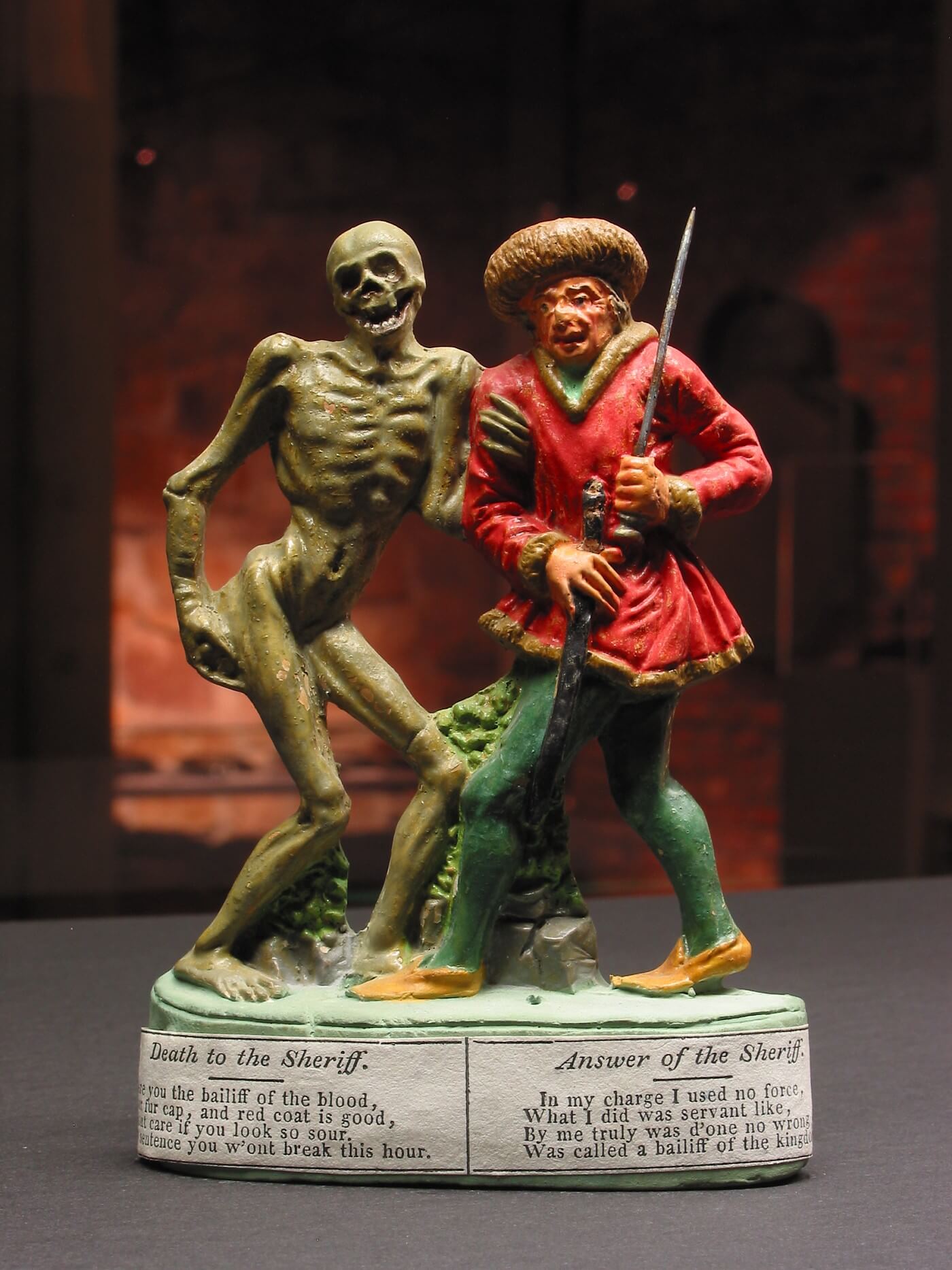
Death to the Sheriff.
Are you the bailiff of the blood?
Your fur cap, and red coat is good,
I don't care if you look so sour.
My sentence you w'ont break this hour.
Answer from the Sheriff.
In my charge I used no force,
What I did was servant-like,
By me truly there was no wrong
Was called a bailiff of the kingdom.
Death to the Blood Bailiff:
Are you, Lord Vogt, over the blood?
In a red skirt and a belted hat
You see sawr/don't turn me to it/
My Ortheil no one can break.
The Blood Warden:
In office I don't need violence/
What I did was in the form of a servant:
Through me, no inequality has occurred/
Therefore, I am called a Vogt of the Empire.
Death to the Fool.
Well harry, jump up with speed,
Tuck thy self up, let thee succeed,
Thy club, thou mayts quit at once,
Drive out your sweat that will my dance.
Answer of the Fool.
Oh woe! I would rather carry woud,
And four times a day I should be beaten,
Of my master and his men,
Than to fight with this meaner man.
Death to the Fool:
Wolauff heyne you must jump now/
Protect yourself and let yourself be carried:
Your piston might stay for a long time now/
My dance will make you sweat.
The Fool:
Oh dear, I wanted to apply wood/
And all day four times they are beaten:
From the heart of mine and his servants/
So I must fight with the Dürrling.
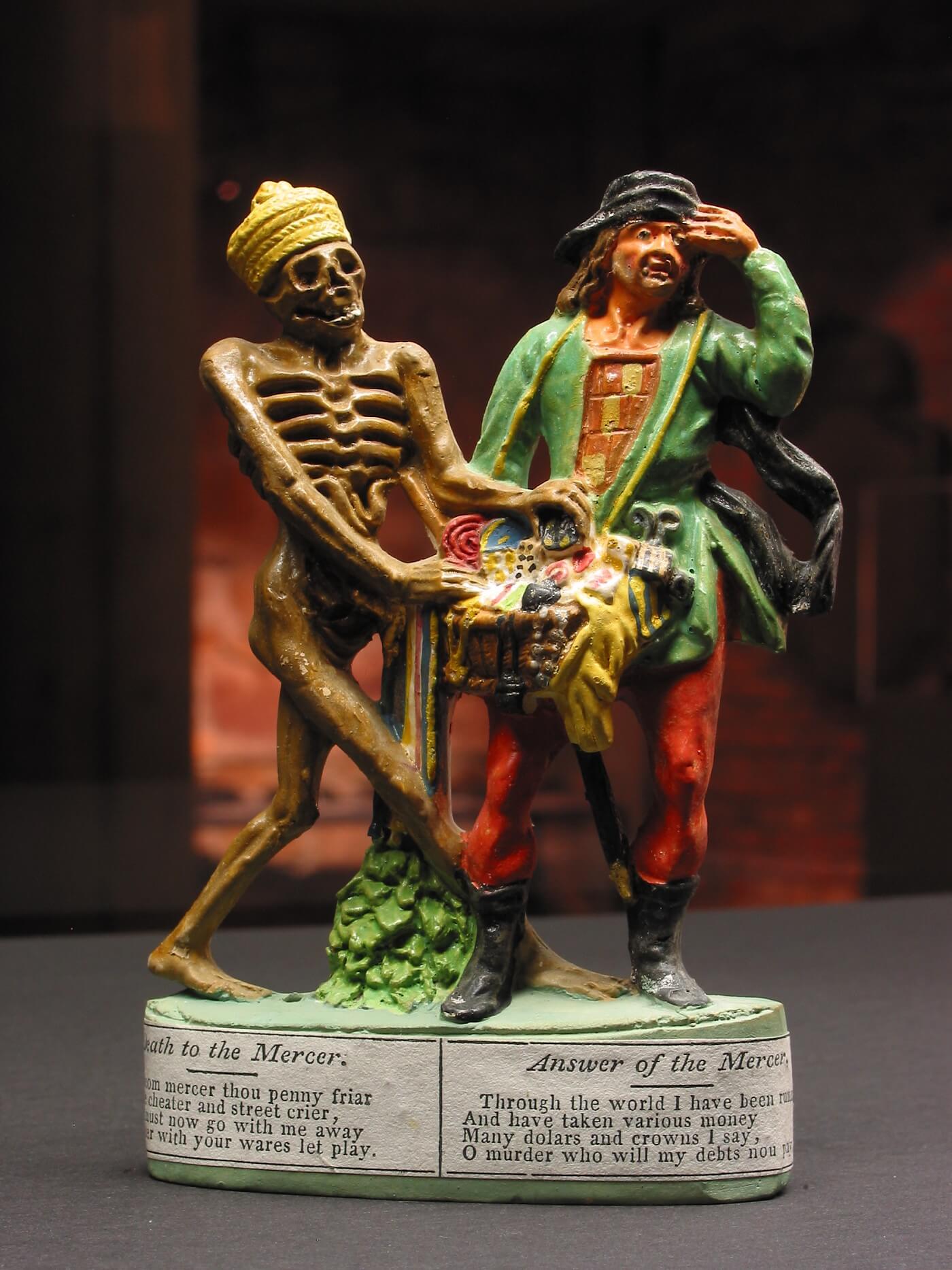
Death to the Mercer.
Welcome mercer thou penny friar
People cheater and street crier,
You must now go with me away
Another with your goods let play.
Answer of the Mercer.
Through the world I have been running,
And have taken various money
Many dollars and crowns, I say,
O murder who will pay my debts nou.
Death to the shopkeeper:
Wolher Krämer du Groscheneyer/
You people-cheeker and street-screamer/
You must now talk to me about it/
Your limping stuff belongs to someone else.
The shopkeeper:
I have traveled the world/
And I have redeemed all sorts of money/
Many Thalers/Coins/Crowns and Guilders:
0 murder/who will pay my debts now.
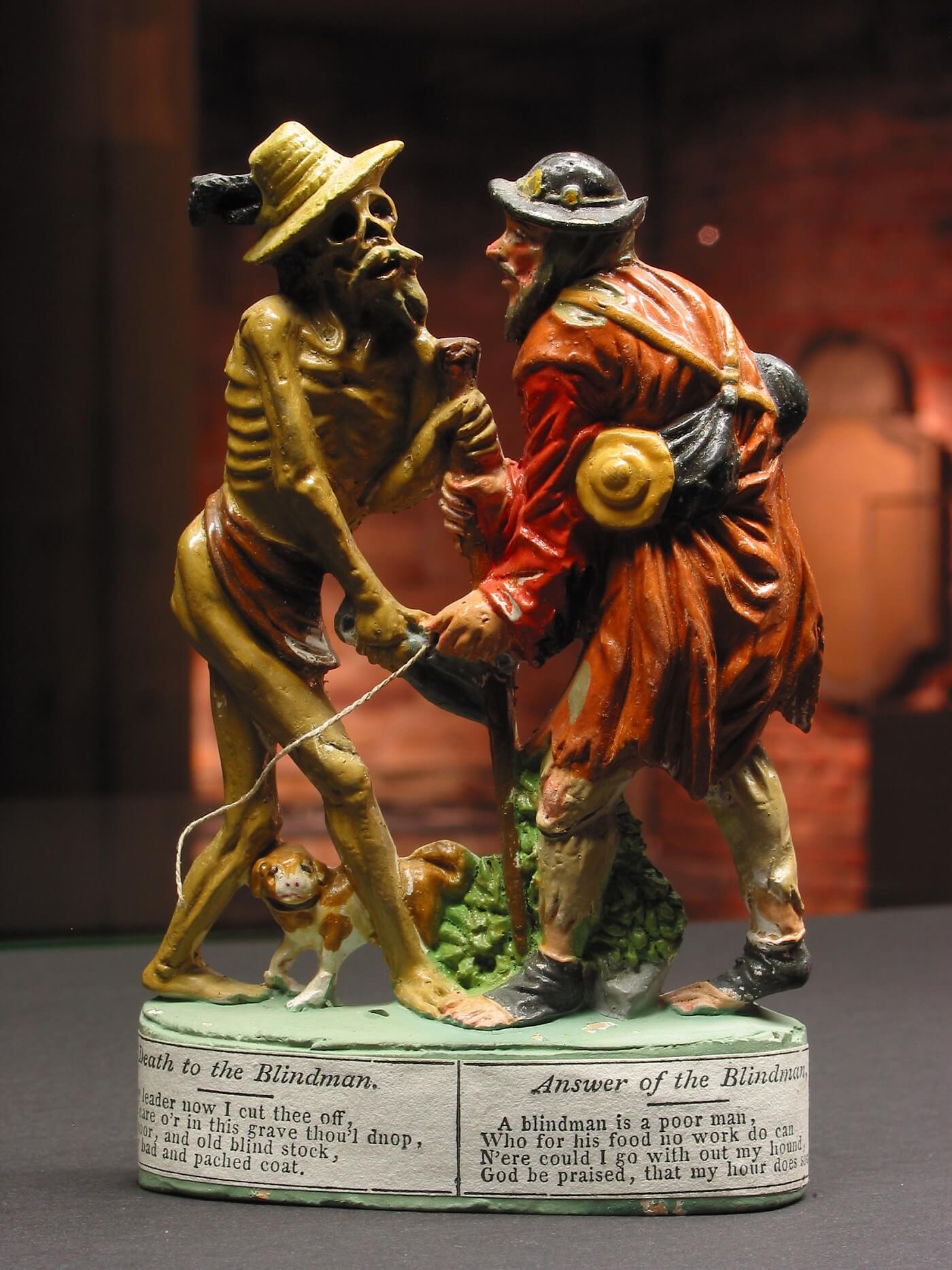
Death to the Blindman.
Thy leader now I cut thee off,
Take care o'r in this grave thou'l dnop,
You poor, and old blind stock,
In thy bad and patched coat.
Answer of the Blindman.
A blind man is a poor man,
Who can do no work for his food
But I could go without my hound,
God be praised, that my hour makes sound.
Death to the Blind:
I'll cut off your signpost/
Be moral or I'll fall in my grave/
You poor blind old stick/
In your evil last skirt.
The blind man:
A blind man, a poor man/
His must and bread cannot be won/
Can't I take a single step without my dog?
Praise be to God, that here is the hour.
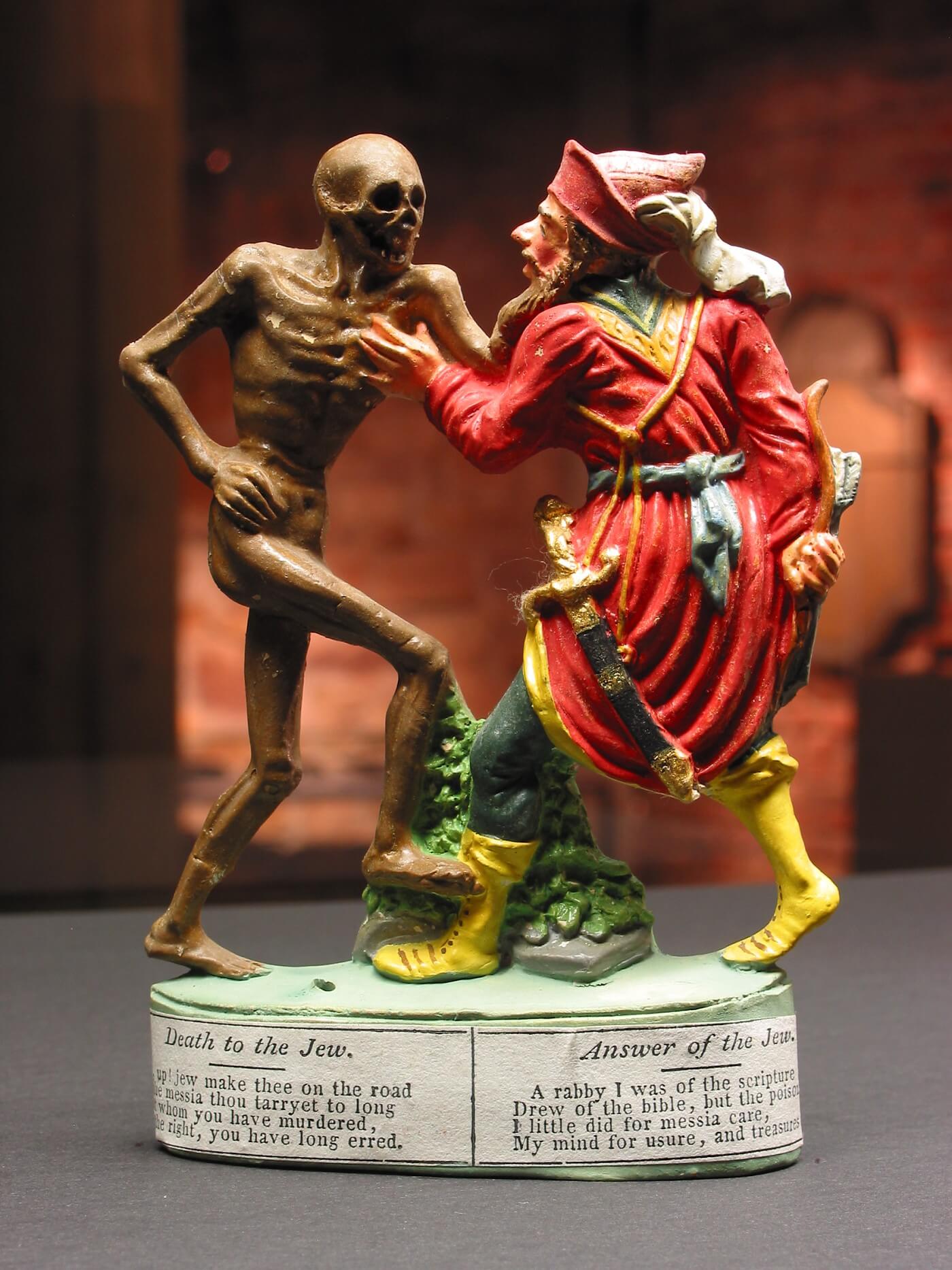
Death to the Jew.
Up, up! jew put thee on the road
For the messiah thou tarryet to long
Christ whom you have murdered,
Was the right, you have long erred.
Answer of the Jew.
A rabby I was of the scripture
Drew of the bible but the poison,
I little did for messianic care,
My mind for usure, and treasures were.
Death to the Jew:
Hujum Jud/ get on the journey/
Your Messiae has waited too long:
Christ whom you have murdered
Was he right/you have been wrong for a long time.
The Jew:
I was a rabbi of the scriptures/
The Bible only contained poison:
Very little like Messiah's dress/
Pays more attention to valuation and usury.
erroneously the text
affixed to the figure "The Heathen".
Photo: Frank Hellwig © Museum of Sepulchral Culture, Kassel, Image Archive
In the figure pairs "Death and the Jew" and "Death and the Heathen", the text strips were accidentally swapped by the manufacturer.
The features used to identify the person depicted here as a "Jew" are found in the style of his clothing, particularly its yellow color. In Western color symbolism, yellow was associated with sinful qualities and thus carried negative connotations. As early as the 12th century, Jews were required to wear a yellow hat—often also bearing the emblem of a yellow ring, the precursor to the yellow Star of David—to identify them as non-Jews. The fact that the figure's coat is also yellow underscores this point. Another striking feature is the money pouch attached to his belt, from which numerous coins are spilling. This detail not only reinforces the centuries-old stigma of the Jew as a shrewd moneylender and usurer, but also perpetuates and reinforces it. The relatively large hands are a subtle expression of the same message. Other physical characteristics also point to negative and defamatory attributions. This includes the red coloring of the beard and hair, which in art history has often characterized Judas, considered the betrayer of Jesus who delivered him up to death. The dialogue text also takes up this theme. While Death accuses the Jew of believing in a "false" Messiah and of murdering Jesus, the Jew discredits the Bible as poison and confesses to his true interests: usury and treasures. Thus, words are put into the Jew's mouth that reinforced prevailing clichés and stereotypes, thereby promoting sweeping generalizations that persist to this day.
In the German-language version of the Zizenhausen Dance of Death, the dialogue text between Death and Jew is different, but the message is the same.
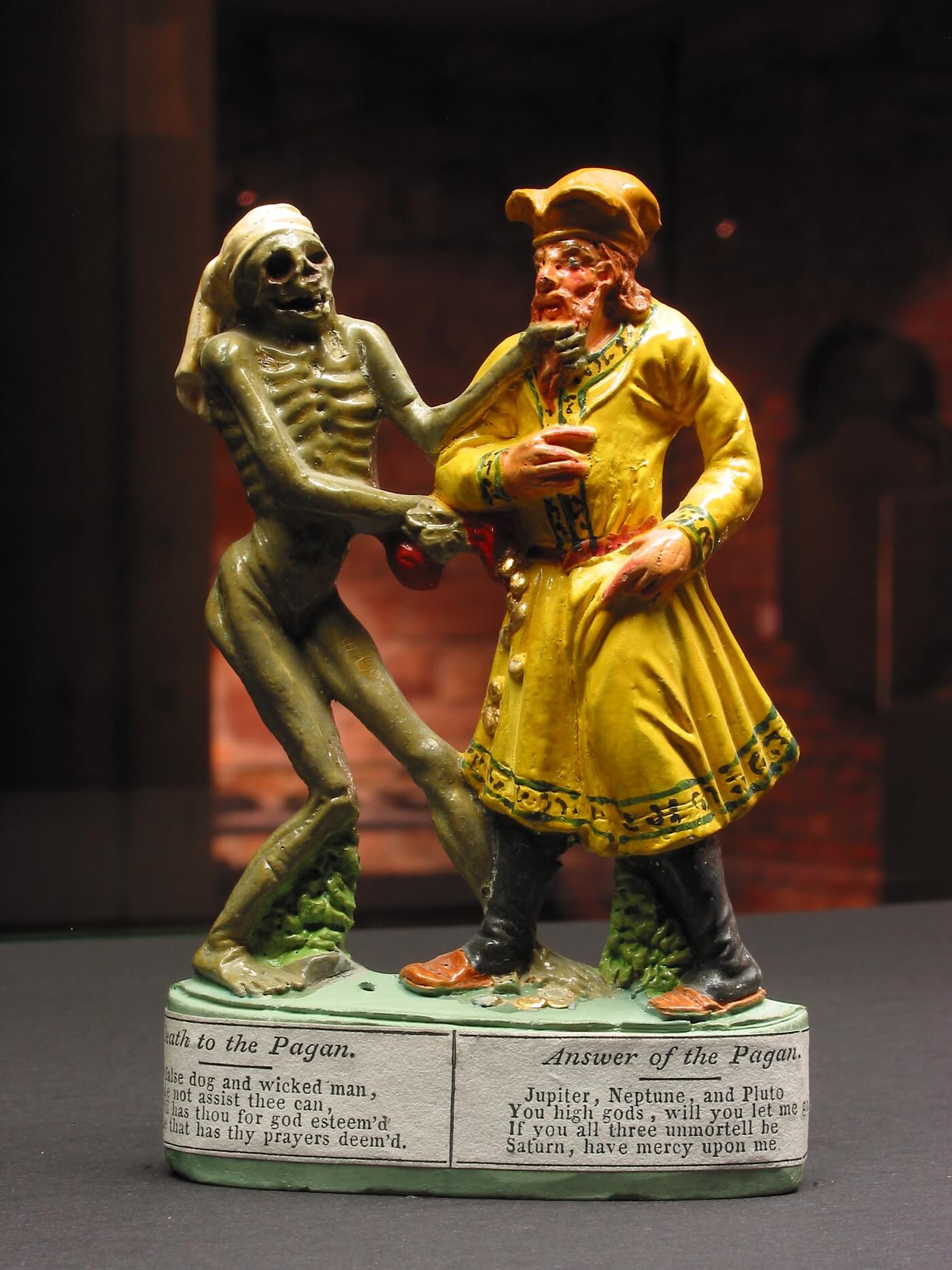
Death to the Pagan.
Come false dog and wicked man,
Thy idols cannot assist thee,
The devil has thou for god esteem'd
T was he that has thy prayers deem'd.
Answer of the Pagan.
Jupiter, Neptune, and Pluto
You high gods, will you let me go.
If you all three are unmortal be
Saturn, have mercy upon me.
Todt zum Heyden:
Come false dog and godless man/
Your idol cannot help you/
You honored the devil as God/
He has answered your prayer.
Der Heyd:
Jupiter/Neptune and Pluton/
Your highest god will not let me go:
When all three of you are immortal/
Saturn, have mercy.
In the figure pairs "Death and the Heathen" and "Death and the Jew", the text strips were accidentally swapped by the manufacturer.
The person described here as a "heathen" can be identified as a Seljuk. This is recognizable by their traditional red clothing and matching cap, as well as their characteristic scimitar. The Seljuks were a Turkic dynasty that reached its zenith in the 11th century. Under their first, semi-legendary ruler, Seljuk, the Seljuks converted to Islam. They are Sunni Muslims.
At the time the Dance of Death was created, all non-Christians were referred to as pagans, which is why the mention of the Roman gods in the dialogue text, along with the simultaneous pictorial representation of a Muslim, should not be surprising.
In the dialogue, Death refers to the heathen as a false and godless man. This reflects an exclusivist Christian attitude, which certainly existed at the time the Zizenhausen Dance of Death was created, but is now long outdated.
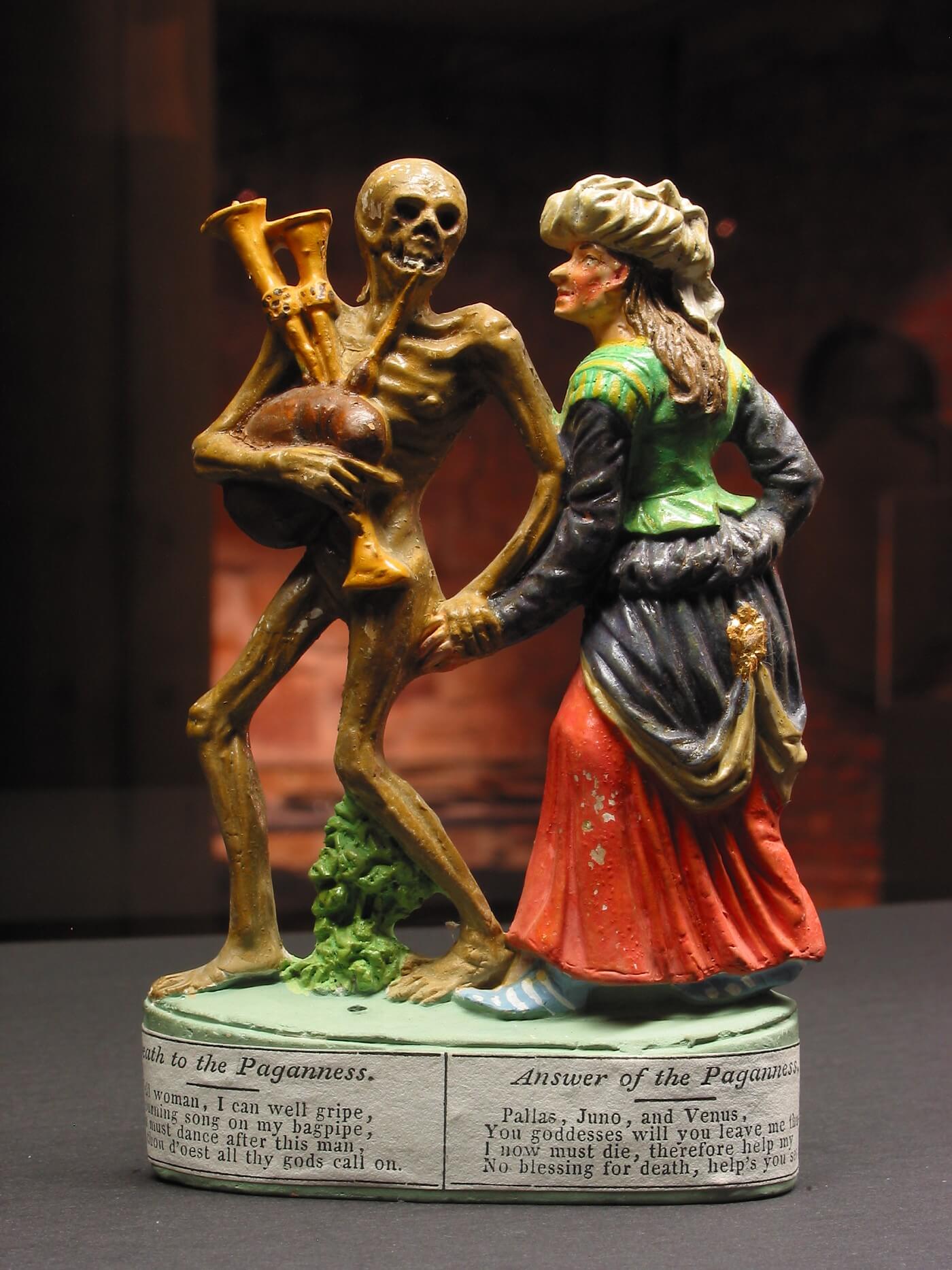
Death to the Paganness.
Well woman, I can well gripe,
A mourning song on my bagpipe,
Thou must dance after this man,
Tho thou d'oest all thy gods call on.
Answer of the Paganness.
Pallas, Juno, and Venus,
You goddesses will you leave me thus,
I now have to die, so help me
No blessing for death, help's you see.
Todt zur Heydin:
I can / Heydin / grasp nicely /
A funeral dirge on the bagpipes/
You must dance like your husband/
Are you already calling upon all the gods?
The Heydin:
Juno/ Venus and also Pallas/
May Goddess grant you mercy that
I must die / help me out of my distress/
No blessing helps in the face of death.
The person described as a "heathen" could, based on her clothing and the associated dialogue, belong to the Sinti and Roma. Various terms are used in medieval sources to describe this ethnic group, including "heathens."
It would also fit this assumption that the Sinti and Roma frequently performed as minstrels and musicians, since Death mentions in the dialogue that he wants to play a funeral song on the bagpipes. This illustrates the anti-Gypsyism already prevalent in the Middle Ages, as the Sinti and Roma were stereotypically perceived as foreign and musical.
The Sinti and Roma do not have their own religion, but belong to various religions. Only ancestor worship is influenced by Hindu structures across the group.
Roman goddesses are mentioned in the dialogue between the pagan woman and Death. At the time the Zizenhausen Dance of Death was created, the term "heathen" was generally used for all people who did not belong to the Christian faith. This term is now obsolete.
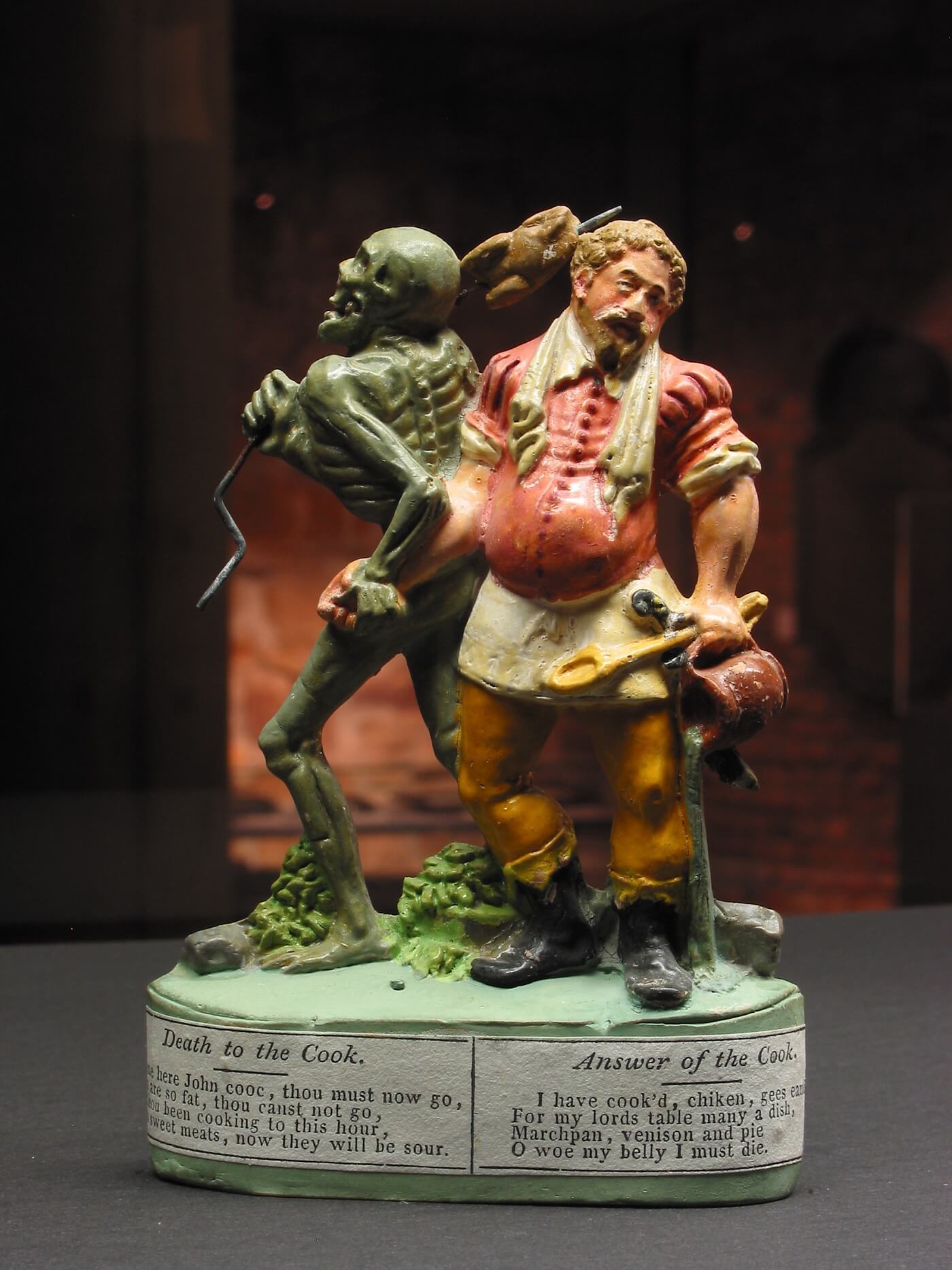
Death to the Cook.
Come here John cooc, thou must go now,
Thou are so fat, thou canst not go,
Have you been cooking this hour,
Much sweet meats, now they will be sour.
Answer of the Cook.
I have cooked, chiken, geese and fish,
For my lords table many a dish,
Marchpan, venison and pie
Oh woe my belly I must die.
Todt to the cook:
Come here Hans Koch, you must get away from it/
How fat you are / you can hardly walk:
Have you already cooked much sweeter lick/
Will you now be able to get away from it?
The cook:
I cooked chicken / goose and fish
My lords, many times over the table/
Venison / Pie and Marzipan:
Oh no, my stomach hurts/I have to get rid of it.
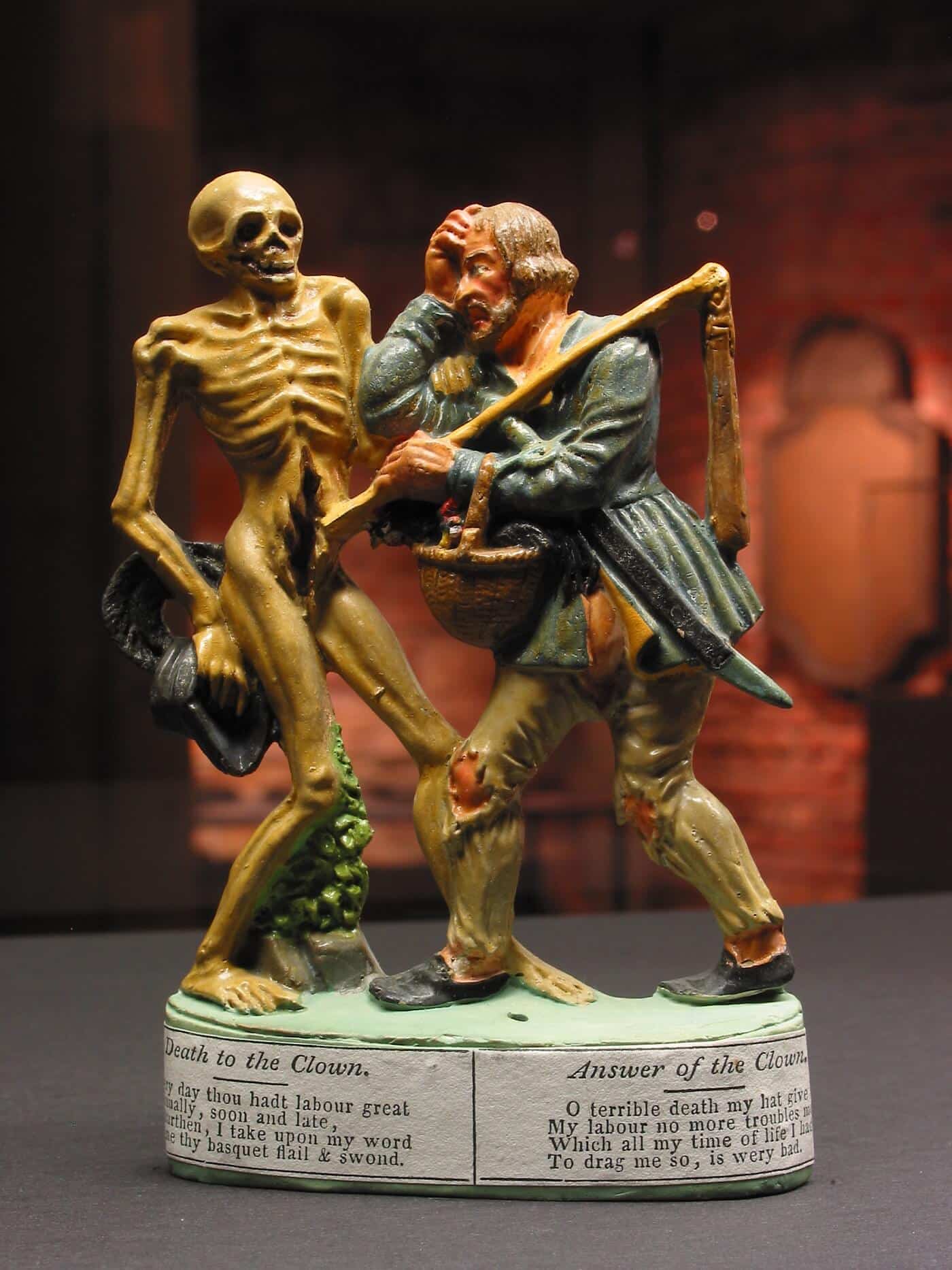
Death to the Clown
Every day thou hadt labor great
Continually, soon and late,
Thy birth, I take upon my word
Give me thy basset flail & swond
Answer of the Clown.
O terrible death my hat gives me,
My labor no longer troubles me
Which all my time of life I had
To drag me like that is very bad.
Todt zum Bawren:
You had a lot of work that day/
Early and late without intermission/
I will lift your burden from you.
Give me a basket/flail/dägen.
The Bawr:
O Grimmer Todt give me my hat/
My work no longer hurts me/
The things I have done in my day/
Why do you accuse me, poor old man?
why the farmer is called "the Clown" here in English.
Photo: Frank Hellwig © Museum of Sepulchral Culture, Kassel, Image Archive
See here the mirror of all world
Who therefore is presented to us.
That we the beginning middle & end
Attentive consider with speed.
The beginning in paradise,
Was glorious, full of honor and praise
There of, followed, soon the fall,
And drew us in this, callamity all.
Behold here the mirror of the whole world/
The one who is therefore presented to us/
That we begin / middle and end/
They look diligently and nimbly.
The beginning in paradise/
What is heartfelt / full of praise / honor and accolades:
This is soon followed by the tiresome pallor/
And plunges us into such a vale of tears.
That which should otherwise be mine/
Immortal / beautiful and angelic:
Which we also cover large and small/
The creatures of God in common.
They should prevail rationally/
And to possess everything eternally/
May God have mercy on you/
In sin, one is corrupted without measure or number.
The crown and scepter were lost/
And they saw nothing but the wrath of God/
Then cruel death swept away swiftly/
Strangle all human beings.
All that lives is the same as the herb/
With his scythe down hawt/
No one was so great and glorious/
He could not grasp the hair.
And shoves him into the grave/
There must be a dance floor at every place/
But now Death has also died/
And we have won the victory.
Through Christ's death and descent into hell/
He who is ours now in heaven/
And is death reversed in sleep?
He who now welcomes us, dear and precious
In a quiet hour / we go to the bottom
Consideration of mortality/
Improvement of life /
and stood firm in everything
good bite to the end
Death to the Painter.
John Hug Klauber leaves painting off,
We now will once away,
Thy art, pain, labor help's the not
Fate falls thee like others I say
Hast thou terribly painted me
With wife and child won't also be.
Always have God before your eyes
And now trow ruler and pensel on the side.
Answer of the Painter.
My god thou wils't assist me,
While now I must go;
My soul in thy hand, I recommend,
When the hour comes, of my end;
And death my soul does outdrive,
I hope my memory will remain
As long as this work shall remain
God bless you, I am fareway.
Todt to the painter:
Hans Hug Klauber let painting stand/
We want to hear about it again now:
Your art/ toil/ work won't help you/
When you feel like other people:
Have you already made my body horrible?
You will also be like that, with child and wife:
Keep God before your eyes at all times/
Throw Bensel down together with the straightedge.
The painter
My God, you would stand by me/
Because I also have to now:
I commend my soul into your hand.
When my hour comes to an end:
And death drives out my soul.
Hopefully my memory will remain/
As long as you keep this thing:
God protect you, I'm leaving.
Death to the Painter's Wife
What mistress are you mourning like that?
After your child with your cradle must go
For now you won't escape me
Therefore I draw off your hat.
Answer of the Painter's Wife
I have always been addicted
To death, will be no more afflicted
However death, takes hold of me
Takes me with child and man you see.
Todt to the Kirbepfeiffer:
What kind of dance do we want to have?
The beggar or black boy/
My Kirbehans/ game wouldn't be quite/
You wouldn't be at this dance either.
The Kirbepfeiffer:
No fair was half too far for me/
What I didn't have, my loot brought:
Now it's over/ I have to leave with necessity/
The whistle fell into my dung.
the "painter" from the
German-language original by Merian
She became "the painter's wife." © Museum of Sepulchral Culture, Kassel, Image Archive